
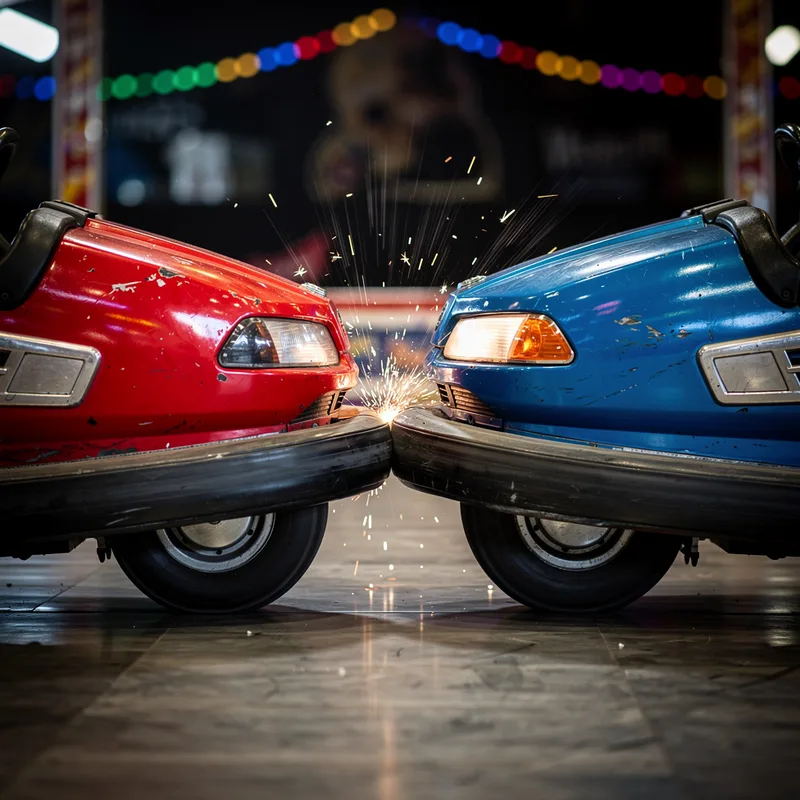
to collide with
 38
3.7
38
3.7

- phrasal verb
- /kəˈlaɪd wɪð/
- Walking alongside the track, she nearly collided with a ramp extending from one of the boxcars.
- collide with each other
- collide with vehicles
- collide with objects
Loading YouTube…
Watch on YouTubeThese are rocks that by chance happen to collide with the Earth.
- These are rocks that by chance happen to collide with the Earth.
- Chuck Jana casually implied correctly that our Galaxy is going to collide with the Andromeda Galaxy.
- And we would, we will be looking for bigger pieces, perhaps even the wreckage of the core of the object that collided with Earth.
- So we have a bullet cluster of galaxies that is collided with each other and passed through.
Examples
-
Yesterday, a Russian fighter jet collided with AUS drone.
-
Something just collided with the cruise ship.
-
In 12 hours, we project he will collide with a planet called "E-arth."
-
You mean it's likely to collide with us?
-
Bear off 60 degrees now, or we are going to collide with you.
-
Suspect vehicle collided with a truck under the 95.
-
The portal opened ahead of her, and she collided with him at the threshold.
Fiction book (1999) -
Entering the waiting room, Patrick almost collided with passengers on their way out.
Fiction book (1997) -
The 70-mile-wide asteroid known commonly as Matilda... is set to collide with Earth in exactly three weeks' time.
-
The car suddenly collided with the wall, causing significant damage.
Synonyms
 ∞
1.0
∞
1.0
To strike someone or something with force
 553
2.4
553
2.4
To hit someone or something with force
 481
2.2
481
2.2
To hit something with great force and cause damage
 111
1.0
111
1.0
To hit something by accident and cause a jolt
 75
2.3
75
2.3
Hit something by accident while moving
 64
3.1
64
3.1
Crash into each other while moving
 18
2.1
18
2.1
To hit someone or something by accident while moving
 13
2.2
13
2.2
To hit each other and make a loud sound
 3
2.7
3
2.7
Hit something by accident when you move and touch it


 1
5.9
1
5.9
To hit something with strong force while moving

To move quickly and hit something hard

Hit something suddenly
Antonyms

How Forceful
311
2.1
 481
2.2
38
3.7
18
2.1
75
2.3
15
3.1
481
2.2
38
3.7
18
2.1
75
2.3
15
3.1
Surface Forms
Morphology
The verb 'collide' already encodes crashing or striking, and the preposition 'with' simply marks the entity involved; together they form the straightforward meaning 'to hit something/someone while moving.' This verb+preposition pattern is common across languages (e.g., Spanish 'chocar con', French 'heurter'), so a B1 learner who knows both constituents will readily infer the MWE's meaning.
Etymology
The verb collide with gives a clear picture: two moving things come together suddenly and hit each other, where collide is the sudden hit and with shows meeting another object, like cars that crash on the road. So collide with means 'to hit something or someone while moving'.