
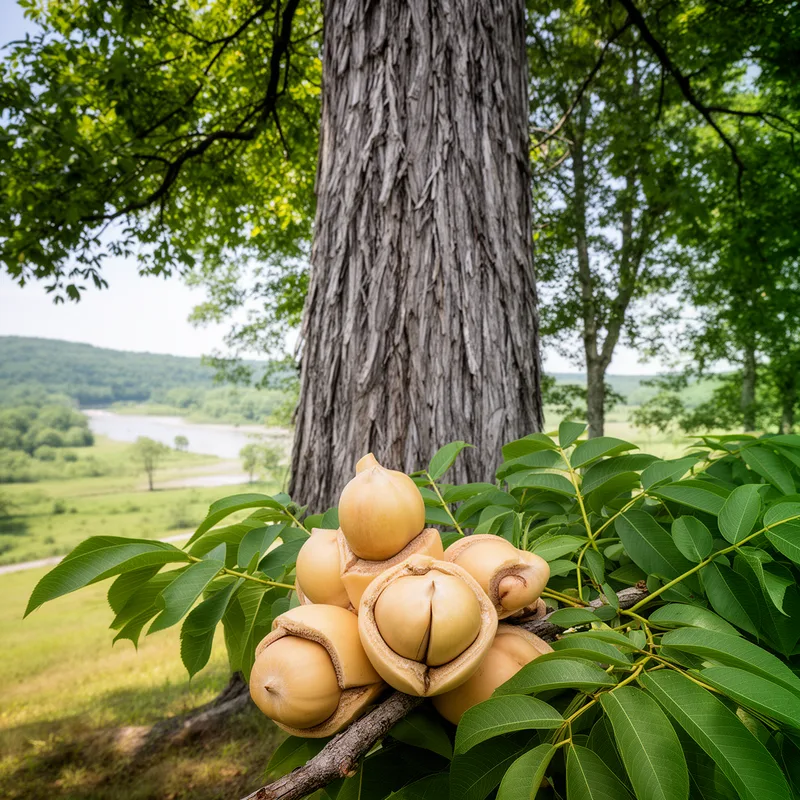
big shellbark
- noun
- Specialized
- Its enormous nut easily distinguishes the big shellbark from its shagbark cousin.
Examples
-
The big shellbark can be found in river valleys throughout the eastern United States.
-
The big shellbark tree can grow over 100 feet tall.
-
Botanists often study the big shellbark for its unique adaptation to floodplain environments.
-
Many big shellbarks are found in the Appalachian region.
-
The big shellbark produces much larger nuts than other hickory trees.
-
In autumn, the leaves of the big shellbark turn a brilliant yellow.
-
Many wildlife species depend on the big shellbark for food and shelter.
Synonyms

A hickory tree that grows in the eastern United States and has very large edible nuts

A tree from eastern North America with large nuts and shaggy bark

A large tree from the eastern United States that makes very big, sweet nuts
A North American tree with loose grey shaggy bark that makes large edible nuts

A North American hickory tree with thick, peeling grey bark and large edible nuts

A large hickory tree in eastern United States that makes much larger nuts than the shagbark hickory

A tree in the eastern United States that makes very large edible nuts
Surface Forms
Morphology
The phrase is a simple adjective + noun composition where 'big' (large) directly modifies 'shellbark' (a type of hickory tree), so the meaning 'a large shellbark tree' is transparently derived from the parts. This straightforward modifier-noun pattern is common cross-linguistically and would be immediately clear to a B1 learner who knows both constituent words.
Etymology
The name big shellbark comes from the tree's thick, rough outer layer and very large nuts. People noticed the heavy bark looked like a protective shell, so the name stuck and today big shellbark means a large hickory tree with very large 'nuts'.

