

king nut
- noun
- US
- The king nut tree produces one of the largest edible nuts found in North American forests.
Examples
-
Unlike the shagbark hickory, the king nut has a much thicker shell.
-
Many animals enjoy eating the king nuts that fall from the trees.
-
Hikers often search for king nuts as a source of food in the wild.
-
The king nut tree can grow up to 100 feet tall.
-
The king nut tree produces one of the largest edible nuts found in North American forests.
-
Many animals enjoy eating the king nuts that fall from the trees.
-
Hikers often search for king nuts as a source of food in the wild.
Synonyms

A large tree from the eastern United States that makes very big, sweet nuts

A tree from eastern North America with large nuts and shaggy bark

A hickory tree that grows in the eastern United States and has very large edible nuts
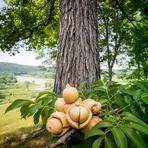
A large hickory tree from the eastern United States with very large nuts

A large hickory tree in eastern United States that makes much larger nuts than the shagbark hickory
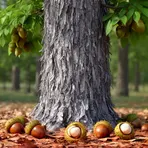
A North American tree with loose grey shaggy bark that makes large edible nuts

A North American hickory tree with thick, peeling grey bark and large edible nuts
Surface Forms
Morphology
The compound is compositionally built from 'king' + 'nut', so a learner who knows those words can infer it refers to a notable or prominent nut (or nut-bearing tree). However, the specific botanical meaning — a particular hickory species producing larger nuts — is not directly predictable from the constituents, so the relation is only partially transparent to B1 learners.
Etymology
King nut comes from the very large edible nut the tree produces, because people called the nut a 'king' for its size and value. So the name means a hickory tree that makes this big, edible nut.

