

Carya laciniosa
- noun
- Specialized
- The nuts of the Carya laciniosa are larger than those of most other hickories.
Examples
-
The Carya laciniosa tree is often recognized by its shaggy bark and large nuts.
-
The Carya laciniosa is commonly found along riverbanks in the Midwest and eastern United States.
-
Botanists carefully studied the bark patterns of Carya laciniosa to differentiate it from similar species.
-
The Carya laciniosa tree produces large nuts.
-
I found a Carya laciniosa in my backyard.
-
In the eastern United States, the Carya laciniosa thrives in rich, moist soils.
-
The nuts from the Carya laciniosa provide a rich source of food for local wildlife.
Synonyms
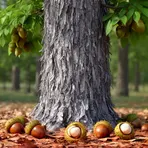
A North American tree with loose grey shaggy bark that makes large edible nuts

A North American hickory tree with thick, peeling grey bark and large edible nuts
Surface Forms
Morphology
Carya + laciniosa
This is a Latin scientific binomial: 'Carya' names the hickory genus but 'laciniosa' is a Latin adjective not listed in the learner-facing dictionary entry, so the specific species sense is not transparently derivable from everyday English word knowledge. Binomial nomenclature and Latin modifiers are domain-specific and not predictable to a B1 learner even if they recognise 'Carya' as a tree genus, making the overall term opaque.
Etymology
Carya laciniosa comes from old words: Carya means 'nut' and laciniosa means 'fringed' or 'torn', a picture of its loose, shaggy bark. So the name points to the tree's very large 'nuts' and its shaggy 'bark', which helps you remember this hickory.

