
beast of burden
 5
3.4
5
3.4

- noun
- /biːst əv ˈbɜrdən/
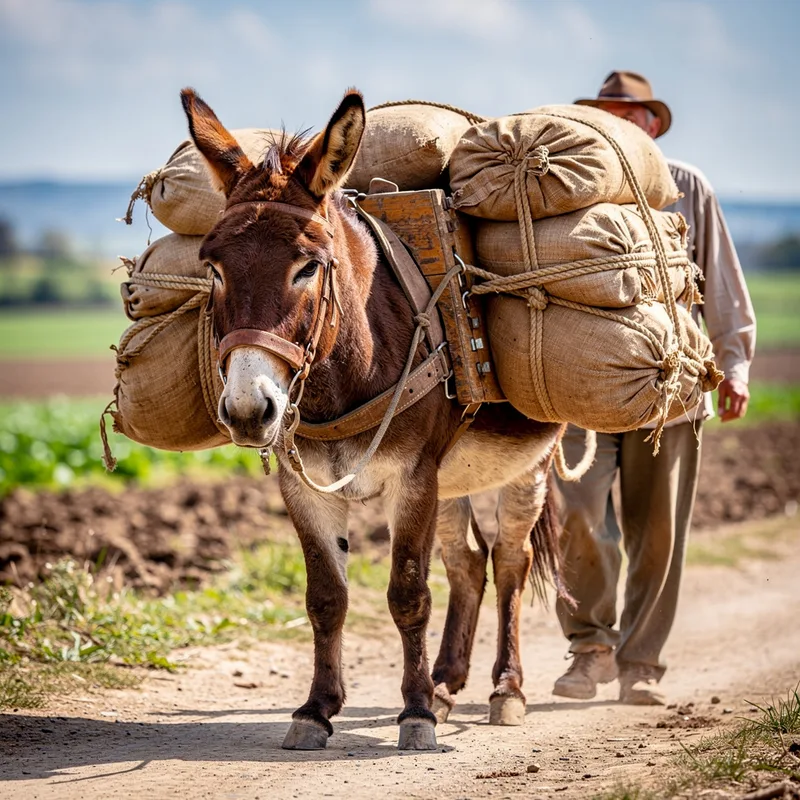
- In many rural areas, the donkey is often considered a beast of burden due to its strength and reliability for carrying heavy loads.
- beasts of burden and animals
- a donkey as a beast of burden
- beasts of burden, like camels
Loading YouTube…
Watch on YouTubeHe does not understand when he is confuted, he's an ass, a donkey, you know, a beast of burden.
- He does not understand when he is confuted, he's an ass, a donkey, you know, a beast of burden.
- I'll never be your beast of burden.
Examples
-
FYI for those of you on small acreages and needing a beast of burden, consider sheep.
Blog text (9) -
Men, women, children of people on the move, massive lines of wagons and beasts of burden carried their possessions.
-
The beast of burden will always be necessary.
-
It's not large enough for a beast of burden, and it's too large for a pet.
-
The riders were no less miserable than their beasts of burden.
Fiction book (1990) -
Camels and donkeys are just beasts of burden.
Blog text (18) -
People keep their cattle in patrilineal herds, where men oversee their care, surveillance, and training as beasts of burden.
Academic text (2002) -
Farmers rely on horses as their primary beast of burden for transporting goods across large fields.
-
Historically, elephants have been used as a beast of burden in logging operations, aiding in the movement of heavy timber.
Synonyms
 2
3.5
2
3.5
An animal that carries loads, like a mule or donkey
 1
3.9
1
3.9
An animal like a horse or ox that pulls heavy loads on a farm


 1
2.8
1
2.8
A trained creature people use to pull and carry heavy loads like horses or oxen
Antonyms


How Strong

Surface Forms
Morphology
beast + of + burden
The meaning 'an animal used for carrying loads' is directly and compositionally derived from 'beast' (animal) + 'burden' (a load) with the linking preposition 'of', so a B1 learner who knows the constituents can infer the phrase. This noun-of-noun construction is cross-linguistically common and follows ordinary English composition patterns, making the MWE immediately comprehensible.
Etymology
Beast of burden comes from old farming life when people used strong animals to carry heavy loads. The word beast meant 'animal' and burden meant 'load', so the phrase paints a picture of an animal doing hard work and means 'an animal kept to carry loads or do heavy work'.