
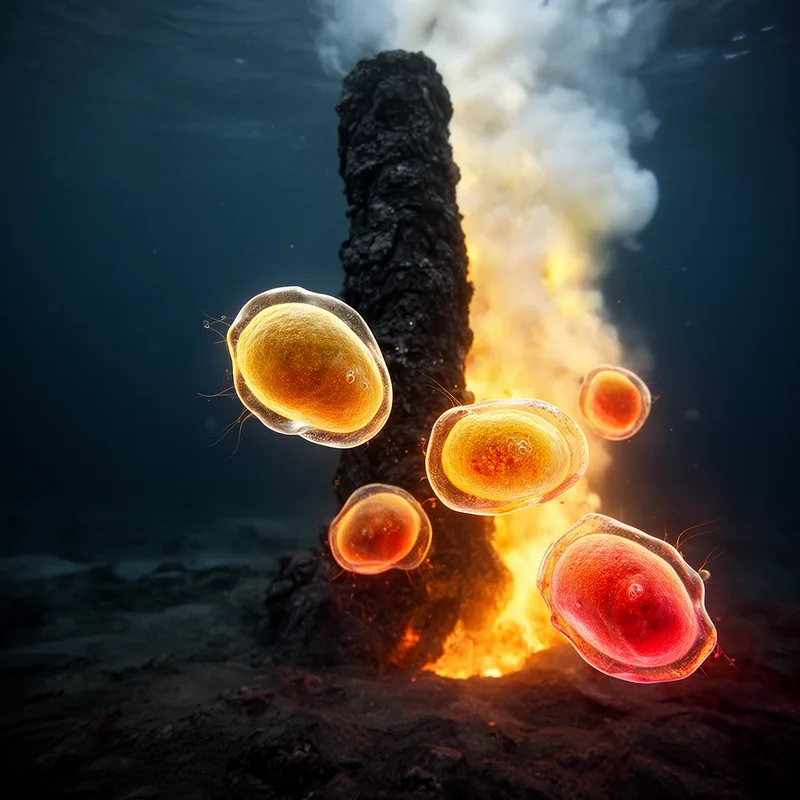
archaea
 2
9.9
2
9.9

- noun
- /ɑrˈkiːə/
- Specialized
 :
arqueas
:
arqueas
- But they are also turning up in more mundane habitats, including soil and animal guts, although archaea are still generally less abundant than bacteria in these sites.
- archaea and bacteria
- archaea, bacteria, and eukarya
- the third domain: archaea
And beyond the fungi, we also may have these microorganisms called Archaea, which are my personal favourite.
- And beyond the fungi, we also may have these microorganisms called Archaea, which are my personal favourite.
- There are Archaea, which are little microbes that are bacteria like, but they're, they're different.
- And it seems that all complex cells derive from a chimaera between some some kind of genomic chimaera between bacteria and Archaea.
- And so there was another cell existing at the time, the Archaea.
- And so what's found if trnas are compared between bacteria, eukaryotes, Archaea, there's evolutionary divergent.
Examples
-
Hordes of bacteria, Archaea and fungi have evolved to produce powerful enzymes that breakdown tough organic material into digestible nutrients.
-
Some researchers suspect archaea may turn out to play a role in certain pathologies, such as periodontal disease.
Academic text (2004) -
At the genetic level, archaea are about as distinct from bacteria as we are.
Academic text (2001) -
However, studies indicate that the Archaea are related specifically to eukaryotes, including plants and animals.
Academic text (2000) -
In recent studies, he has focused on two hyperthermophilic archaea.
Academic text (1994) -
The census taking of the microbial world is also changing the profile of archaea, the third domain of life.
Academic text (2004) -
So at this scale, what you see here are the three kingdoms of life, which are the bacteria, the Archaea and the eukaryotes.
-
The distinctive biochemistry of archaea makes them another rich source of biotech and other applications.
Academic text (2004) -
The eukaryotes are defined by having a membrane-bound nucleus, yet archaea and bacteria have no membrane surrounding their nucleus.
Academic text (2000) -
The distinctive biochemistry of archaea makes them another rich source of biotech and other applications.
Synonyms
Very small, ancient single-celled organisms different from bacteria that live in hot springs or salt lakes
Very small simple living things that are like early life and often live in hot springs or salty water

A group of single-celled life forms different from bacteria and from animals and plants
Surface Forms
Etymology
Archaea comes from the Greek root archaios, meaning 'ancient'. It shares the same root as archaeology and archaic, so think of archaea as very old kinds of single-celled life often found in extreme places.