
division Archaebacteria
- noun
- /dɪˈvɪʒən ˌɑrkɪˈbæktɪrɪə/
- Archaic
 :
división Archaebacteria
:
división Archaebacteria
- Some textbooks treat division Archaebacteria as a separate kingdom from Bacteria and Eukarya.
Examples
-
The classification of division Archaebacteria has changed as new genetic data have become available.
-
Scientists study the unique adaptations of division Archaebacteria found in extreme environments.
-
The division Archaebacteria includes extremophiles.
-
Many scientists study the division Archaebacteria for its unique properties.
-
Some textbooks treat division Archaebacteria as a separate kingdom from Bacteria and Eukarya.
-
Scientists study the unique adaptations of division Archaebacteria found in extreme environments.
-
The classification of division Archaebacteria has changed as new genetic data have become available.
Synonyms

 2
9.9
2
9.9

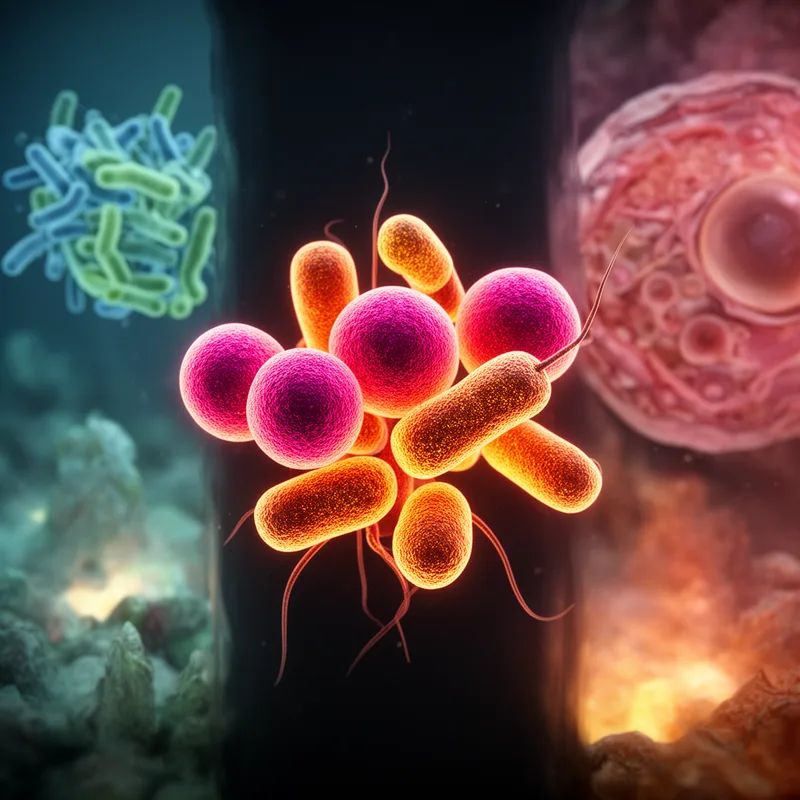
Single-celled living things that often live in extreme places like hot springs or deep ocean vents
Very small, ancient single-celled organisms different from bacteria that live in hot springs or salt lakes

Very small simple living things that are like early life and often live in hot springs or salty water
Surface Forms
Morphology
The phrase combines 'division' (a taxonomic rank) with 'archaebacteria' (a group of microorganisms), so its meaning as the taxonomic group containing archaebacteria is directly derivable from the constituents. Although technical, the composition follows regular noun-noun naming patterns in biology and is cross-linguistically comparable, making it immediately understandable to learners who know both words.
Etymology
Division Archaebacteria comes from how scientists name living things: division means a large 'group' and Archaebacteria combines the Greek parts archaeo meaning 'ancient' and bacteria meaning 'small life', so it pictured 'ancient bacteria'. Because these tiny organisms were very different from other microbes, the phrase came to mean a separate 'kingdom' of 'single-celled' life.