
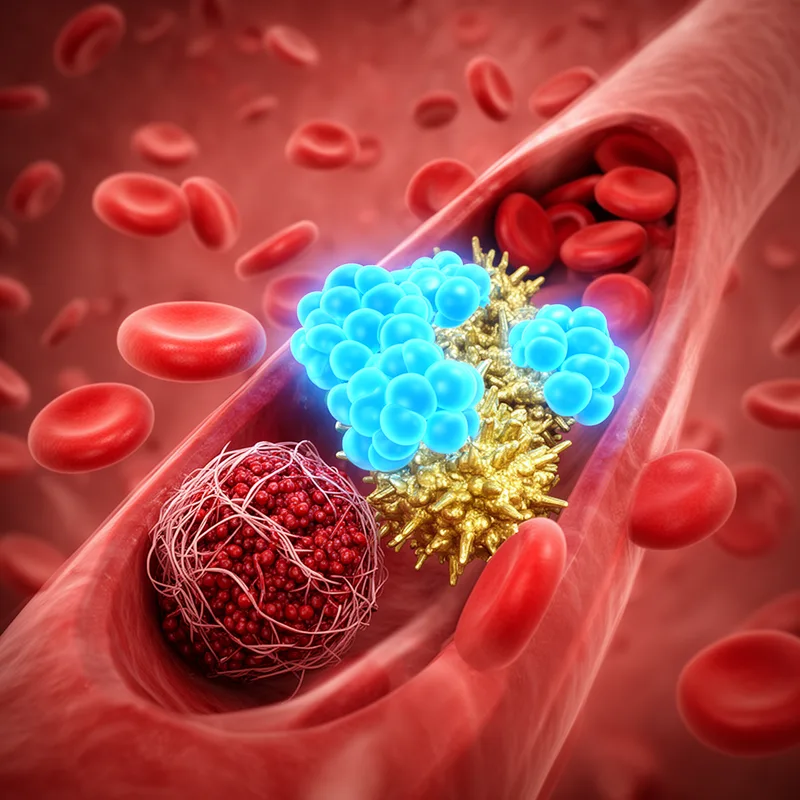
antithrombin
- noun
- /ˌæntiˈθrɑːmbɪn/
- Specialized
- Screening tests for hypercoagulability included normal levels of serum fibrinogen, d-dimers, protein C and S, antithrombin III, but positive antiphospholipid antibodies.
- antithrombin deficiency
- antithrombin III
- antithrombin complex
Examples
-
LMWH is an anticoagulant that works by enhancing the effects of antithrombin.
Academic text (2012) -
The risks were greatest for women with antithrombin deficiency and for those with combined defects.
Academic text (1999) -
Thrombin-antithrombin complex peaked after 15 minutes of infusion and thereafter began to taper off.
Academic text (2002) -
Women with familial thrombophilia, especially those with combined defects or antithrombin deficiency, have an increased risk of fetal loss, particularly stillbirth.
Academic text (1999) -
Antithrombin inhibits factors in the coagulation cascade, including factor Ha (thrombin) and factor Xa.
Academic text (2012) -
The greatly increased risk of stillbirth in women with deficiencies of antithrombin, protein C, and protein S strongly suggests the possibility of uteroplacental insufficiency as a causative factor.
Academic text (1999) -
Antithrombin plays a crucial role in preventing blood clots by inhibiting certain enzymes in the blood.
-
Doctors often prescribe antithrombin to patients at high risk of developing blood clots during surgery.
-
The patient's test results showed a low level of antithrombin, indicating a higher risk for clotting disorders.
Synonyms

 8
5.6
8
5.6

A medicine that slows or stops blood from forming clots

A medicine that stops or slows blood from forming clots

A substance that stops or slows blood from forming clots
Surface Forms
Morphology
Etymology
Antithrombin has three parts: anti- meaning 'against', as in antibiotic, thromb- meaning 'clot', and the protein ending -in, as in insulin. So it is a protein that works 'against clots', which is why it helps prevent blood clots.