

alluvium
- noun
- /əˈluːviəm/
- Specialized
- The river deposited alluvium along its banks after the heavy rains, creating fertile soil for agriculture.
- alluvium soil
Examples
-
Most damage to buildings occurred in areas where the structures had been erected on alluvium.
Academic text (1993) -
In one area we excavated to the north of the large mound, we discovered many pits where the inhabitants had cut through a thin layer of alluvium in order to extract the underlying lime-rich marls.
Academic text (2006) -
The soil was formed in recent alluvium from limestone and exists on flood plains.
Academic text (2009) -
The high porosity of the alluvium could be a factor in the freeze-thaw action.
Academic text (1999) -
The soil was developed in old alluvium (terrace position) from shale limestone.
Academic text (2009) -
Lewisville soils formed in Pleistocene alluvium on stream terraces.
Academic text (1998) -
The streams of the McMurdo Dry Valleys flow through unconsolidated alluvium and are remarkably similar throughout the valleys.
Academic text (1999) -
The soil of the experimental site belongs to the major group of Indo-Gangetic alluvium with well-drained sandy loam texture.
Academic text (2014) -
We propose that as the saturated alluvium freezes, the expansion of the alluvium surrounding a rock rotates the rock until the largest flat side is upward.
Academic text (1999) -
Stone pavements probably do not form in steep reaches because the alluvium drains rapidly, before freeze-thaw processes move the rocks into a stone pavement formation.
Academic text (1999)
Synonyms

Loose soil like sand or clay that a river leaves when it slows

Loose soil and sand that water carries and leaves on banks or fields
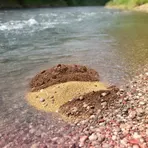
Soil, sand or small stones that a river drops when it slows down

Fine earth left by rivers that is soft and very good for growing crops
How Coarse


Surface Forms
Etymology
The word alluvium comes from the Latin alluere, meaning 'to wash'. So imagine a river 'washing' clay, silt and sand along and leaving layers in its bed or in the area next to the river. Those layers are the rich soil and gravel we call alluvium.