
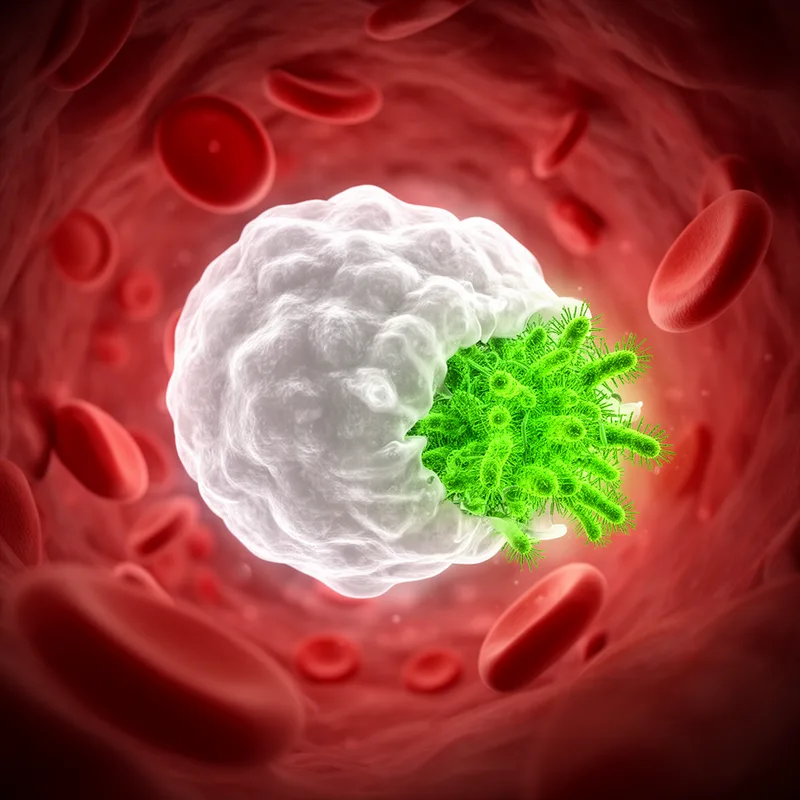
WBC
 7
3.5
7
3.5

- noun
- Specialized
- Findings on the blood workup were normal with the exception of leukocytosis (WBC: 14.0 x 10^9/L).
- WBC count
- white blood cells
Examples
-
Laboratory evaluation revealed a WBC count of 1.8/mm3, hemoglobin 9.7 g/dl, hematocrit of 28.1%, and platelet count of 18,000/mm3.
Academic text (2007) -
Leucocyte (WBC) and erythrocyte (RBC) counts were done on an electronic cell counter (Coulter, UK).
Academic text (2007) -
The patient had an arthrocentesis done that revealed WBC of 38,100 #/cmm.
Academic text (2007) -
When the patient was close to discharge on 11/25/06, the WBC was 5.6 x 10^3/L with 9% eosinophils.
Academic text (2007) -
Relevant laboratory findings were an elevated white blood cell count (WBC) of 12,000 K/cmm.
Academic text (2007) -
Persistent temperature, elevated WBC and ESR counts, wound erythema, or drainage are signs of infection.
Academic text (2005) -
On admission, the white blood count (WBC) was 11.1 x 10^3 /L with 3% eosinophils.
Academic text (2007) -
Findings on the blood workup were normal except for leukocytosis (white blood cell count WBC: 16.9 x 10^9/L).
Academic text (2006) -
The doctor explained that a high WBC count can indicate an infection in the body.
-
Monitoring the patient's WBC levels is crucial for assessing their immune response.
Synonyms
 22
2.5
22
2.5
A cell in the blood that helps the body fight infections
 9
3.3
9
3.3
A blood cell that eats and kills germs to protect the body
 3
5.4
3
5.4
A white blood cell that helps the body fight infection by eating bacteria and fungi

 1
4.6
1
4.6
A blood cell that surrounds and destroys germs

A blood cell that helps protect the body by eating and killing bacteria and other germs
Surface Forms
Morphology
Etymology
The word WBC is short for white blood cell. A helpful way to remember it is to imagine 'white' soldiers in your blood that eat germs like bacteria and fungi, so a high or low WBC count tells doctors how well your immune system is fighting infection.