
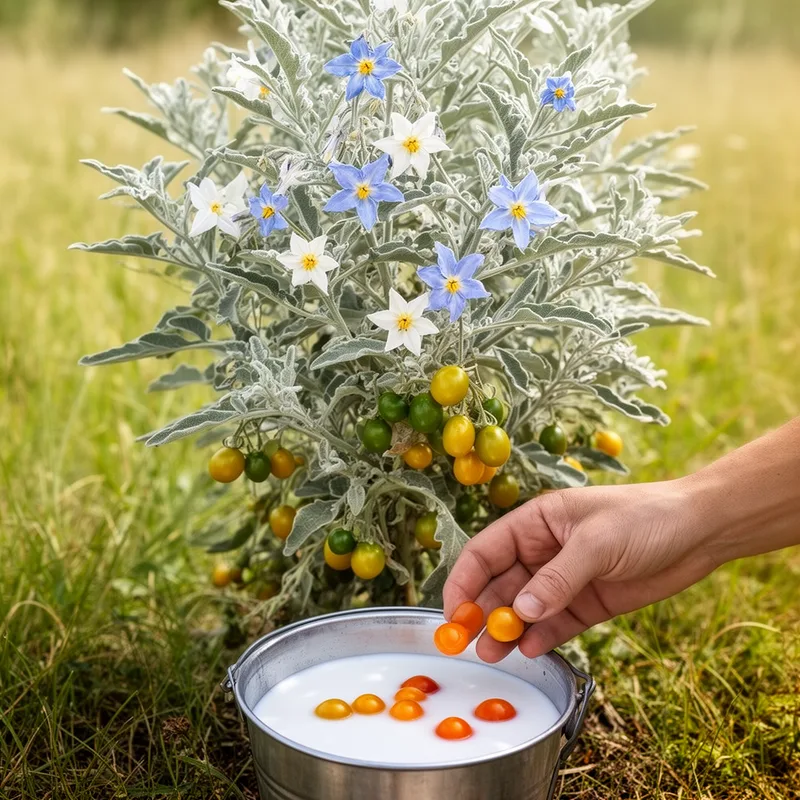
Solanum elaeagnifolium
- noun
- Specialized
- The silvery leaves of Solanum elaeagnifolium make it easy to identify among other weeds.
Examples
-
Solanum elaeagnifolium can be invasive in pastures, outcompeting native grasses.
-
Farmers sometimes use berries of Solanum elaeagnifolium in cheese-making to curdle milk.
-
The Solanum elaeagnifolium is often found in arid regions.
-
Farmers in Texas sometimes cultivate Solanum elaeagnifolium for its unique properties.
-
Farmers sometimes use berries of Solanum elaeagnifolium in cheese-making to curdle milk.
-
The silvery leaves of Solanum elaeagnifolium make it easy to identify among other weeds.
-
Solanum elaeagnifolium can be invasive in pastures, outcompeting native grasses.
Synonyms
A wild plant with silvery leaves and blue or white flowers that makes berries used to curdle milk

A wild plant with silvery leaves and violet, blue, or white flowers that has round berries used to curdle milk
A wild plant with silvery leaves and violet or white flowers that can be poisonous to animals

A wild plant with silvery leaves and round berries that people use to curdle milk

A plant with silvery leaves, small blue or white flowers, and a round berry used to curdle milk

A wild plant with silvery leaves and round berries that people use to curdle milk

A wild plant with silvery leaves, violet, blue or white flowers and round berries used to make milk into cheese
Surface Forms
Morphology
Solanum + elaeagnifolium
This is a Latin binomial (a scientific species name) rather than a compositional English phrase; its meaning relies on taxonomic knowledge and specialized morphology rather than ordinary English word combination. One constituent is not a recognized English word and the other is a capitalized genus name, so a B1 learner who knows the listed constituents would not be able to derive the species meaning from them.
Etymology
Solanum elaeagnifolium is a scientific plant name that describes how the plant looks: Solanum shows it is a 'nightshade', and elaeagnifolium combines elaeagnus, a word for 'olive-like', with folium, the Latin for 'leaf'. That's why the name points to the plant's silvery, olive-like leaves and helps people identify it.

