

Second Sino-Japanese War
- proper noun
- The Second Sino-Japanese War fundamentally shifted the balance of power in East Asia.
Examples
-
During the Second Sino-Japanese War, many civilians suffered greatly.
-
Historians often analyze the causes and consequences of the Second Sino-Japanese War.
-
During the Second Sino-Japanese War, Korea's fate was decided by the victories and defeats of both sides.
-
The Second Sino-Japanese War marked a significant turning point in East Asian history.
-
Historians often analyze the causes and consequences of the Second Sino-Japanese War.
-
The Second Sino-Japanese War fundamentally shifted the balance of power in East Asia.
-
During the Second Sino-Japanese War, many civilians suffered greatly.
Synonyms
 1
8.3
1
8.3

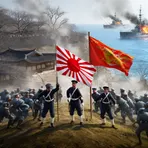
A war between China and Japan from 1894 to 1895 over control of Korea ending in a Japanese victory

A war between China and Japan over control of Korea that ended in a Japanese victory
Surface Forms
Morphology
The phrase combines 'Second' (an ordinal) + 'Sino-Japanese' (relating to China and Japan) + 'war' (armed conflict), so the core meaning — a later war between China and Japan — is derivable from the parts. However, 'Sino-' is a less familiar classical prefix for many B1 learners and the expression functions as a specific historical proper name whose dates and nuance are not predictable from the constituents, so full comprehension requires prior exposure or background knowledge.
Etymology
Second Sino-Japanese War is a literal name: Second means the later war, Sino comes from an old word for 'China', Japanese means 'from Japan', and War is the fighting between the two countries. So the name simply marks it as the second big fight between 'China' and 'Japan'.