
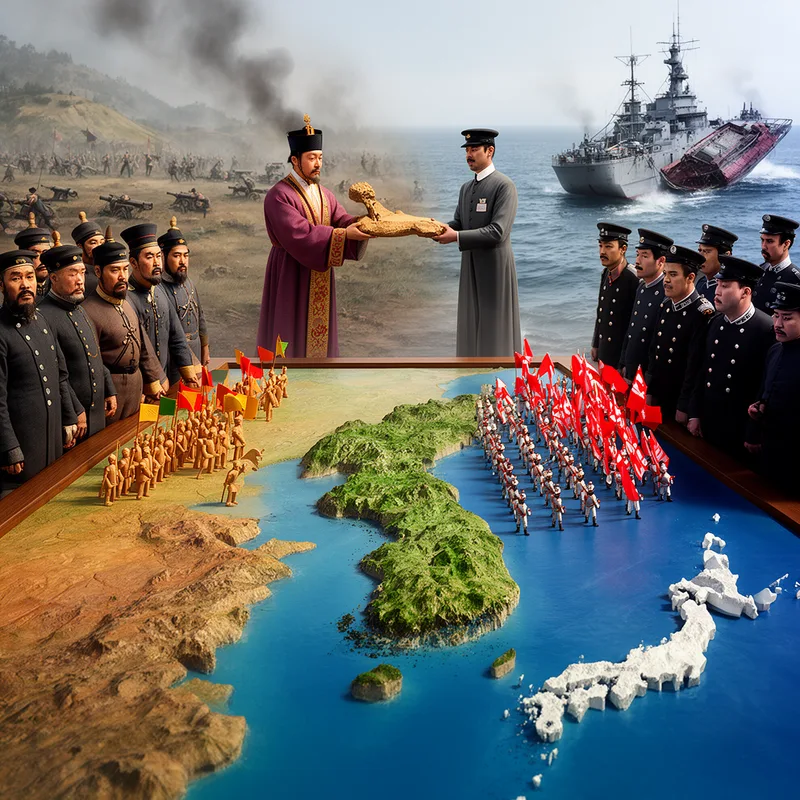
Chino-Japanese War
- noun
- /ˈtʃiːnoʊ dʒəˈpænɪz wɔr/
- During the Chino-Japanese War, Japan decisively defeated China and gained control of Taiwan.
Examples
-
The Treaty of Shimonoseki ended the Chino-Japanese War, ceding Taiwan to Japan.
-
The Chino-Japanese War marked the emergence of Japan as a major world power.
-
Historians often analyze the causes and consequences of the Chino-Japanese War.
-
The Chino-Japanese War marked a significant shift in power in East Asia.
-
Many historians study the Chino-Japanese War for its impact on modern warfare.
-
The Chino-Japanese War was a pivotal conflict that established Japan's dominance over Korea.
-
The Chino-Japanese War highlighted the rise of Japan as a powerful military force in Asia.
Synonyms
 1
8.3
1
8.3

A war between China and Japan from 1894 to 1895 over control of Korea ending in a Japanese victory
A war between China and Japan from 1894 to 1895 that ended in a clear Japanese victory
Surface Forms
Morphology
Chino-Japanese + war
The phrase names a war involving China and Japan and the headword 'war' gives the event type; a B1 learner who knows the country names and 'war' will deduce it refers to armed conflict between those two countries. Although 'Chino-' is an uncommon form (more often 'Sino-' or 'Chinese–Japanese'), the compositional pattern 'X–Y war' is standard cross-linguistically, making the meaning directly inferable from the parts.
Etymology
Chino-Japanese War simply names the two countries involved: Chino for 'China' and Japanese for 'Japan'. It therefore refers to the war those countries fought in 1894-95 over control of Korea.