
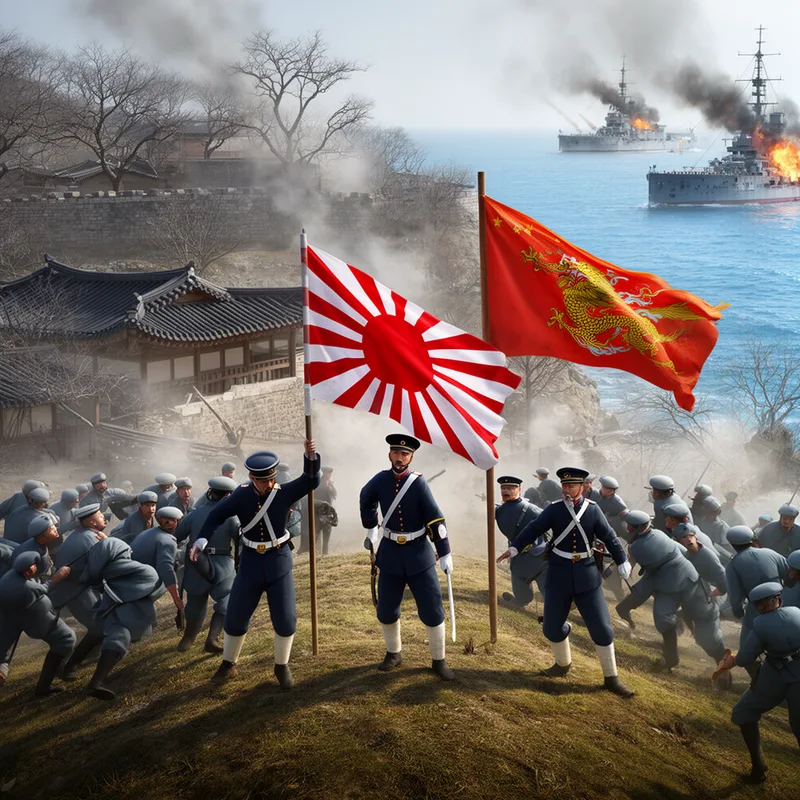
Sino-Japanese War
 1
8.3
1
8.3

- proper noun
- After the Sino-Japanese War of 1894-1895, however, China launched a modernization program in which these graduates played a major role, sending large numbers of students to the U.S. in the early years of the twentieth century.
- Sino-Japanese War of 1894
- Sino-Japanese War of 1894-95
Examples
-
Imperial Japan seized Taiwan from the Qing dynasty in China after the Sino-Japanese War (1894-95) and ruled Taiwan until its defeat in World War II in 1945.
Academic text (2004) -
China ceded Taiwan to Japan after the Sino-Japanese War of 1894-95.
Academic text (2003) -
Negotiations with China never took place, and this decision was passed during the Sino-Japanese War.
Blog text (33) -
After the Sino-Japanese War and the Civil War, Chinese society had an opportunity for educational development in the 1950s.
Academic text (1996) -
If your child is learning about the Sino-Japanese War, have them cook authentic Japanese and Chinese dishes that would have been served at the time.
Blog text (11) -
Public opinion polls during the Sino-Japanese War indicated overwhelming popular support for the Chinese.
Academic text (2000) -
During the Sino-Japanese War, as part of the national sacrifice, ekiben for domestic consumption was made only with rice.
Academic text (1994) -
However, after the Sino-Japanese War of 1894, the beleaguered Qing, weakened by Western colonialism and internal corruption, ceded Taiwan to Japan.
Academic text (1997) -
The Sino-Japanese War, fought from 1894 to 1895, marked a significant shift in power on the Korean Peninsula.
-
Following the Sino-Japanese War, Japan emerged as a dominant force in East Asia.
Synonyms

A war between China and Japan over control of Korea that ended in a Japanese victory
A war between China and Japan from 1894 to 1895 that ended in a clear Japanese victory
Surface Forms
Morphology
Sino-Japanese + war
The noun 'war' makes the general concept clear, and 'Sino-Japanese' is compositionally interpretable as relating to China ('Sino-') and Japan ('Japanese'), so the phrase denotes a war between China and Japan. However, the prefix 'Sino-' is relatively formal/etymological and may be unfamiliar to B1 learners without prior exposure, and the term often refers to a specific historical event, so the relation is only partially predictable.
Etymology
Sino-Japanese War gets its name from the two countries that fought: Sino meaning 'China' and Japanese meaning 'Japan'. It refers to the 1894-1895 war over 'Korea', where Japan won.