
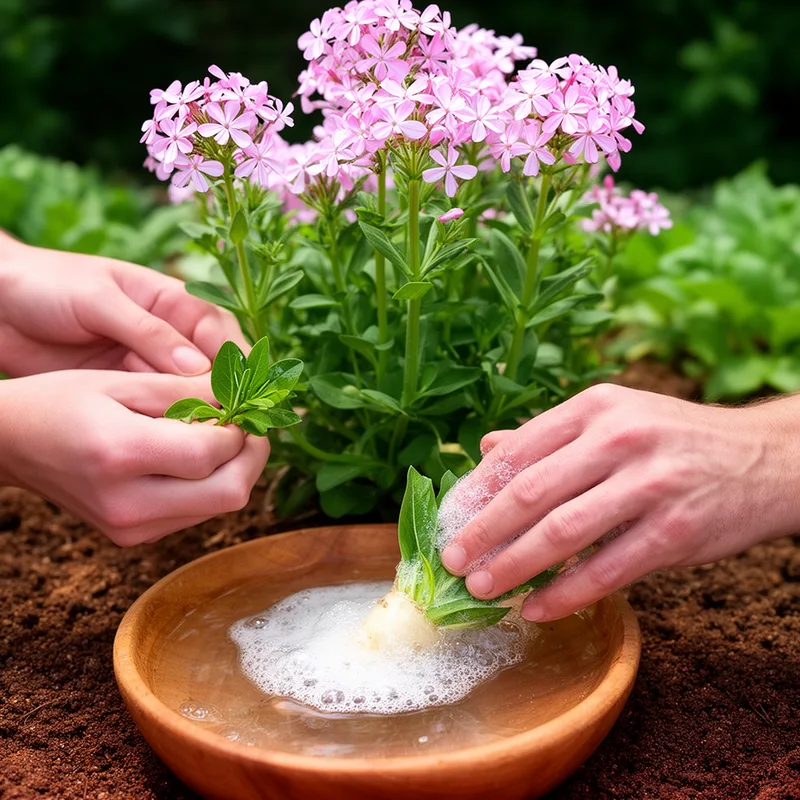
Saponaria officinalis
- noun
- Specialized
- The leaves of Saponaria officinalis have traditionally been used as a natural soap.
Examples
-
She planted Saponaria officinalis in her garden to enjoy its delicate pink blooms.
-
Botanists study Saponaria officinalis for its cleansing properties and attractive flowers.
-
The Saponaria officinalis is often found in gardens.
-
Have you seen the Saponaria officinalis blooming this spring?
-
Many herbalists recommend Saponaria officinalis for its ability to create a gentle, natural soap.
-
In the summer, Saponaria officinalis attracts numerous pollinators with its beautiful pink flowers.
-
Gardeners appreciate Saponaria officinalis not only for its lovely blooms but also for its historical use as a cleansing agent.
Synonyms


 1
9.9
1
9.9
A plant with pink or white flowers whose crushed leaves make a natural soap

A plant with pink or white flowers whose crushed leaves make a soap-like liquid
A plant with pink or white flowers whose leaves make natural soap when crushed

A plant from Europe with pink or white flowers whose leaves make soap when crushed
Surface Forms
Morphology
This Latin binomial is compositional: 'Saponaria' denotes a soap-producing herb and 'officinalis' signals medicinal use. A learner who knows those constituent meanings can directly infer it refers to a soapwort-type plant with medicinal associations, so the MWE is transparent.
Etymology
Saponaria officinalis gets its name from a simple image: when you rub or bruise the leaves and roots they foam like soap, so people linked it to sapo, Latin for 'soap'. The second word, officinalis, shows the plant was 'used in medicine' or sold in old shops, so the name reminds us it is the common 'soapwort' used for cleaning today.