
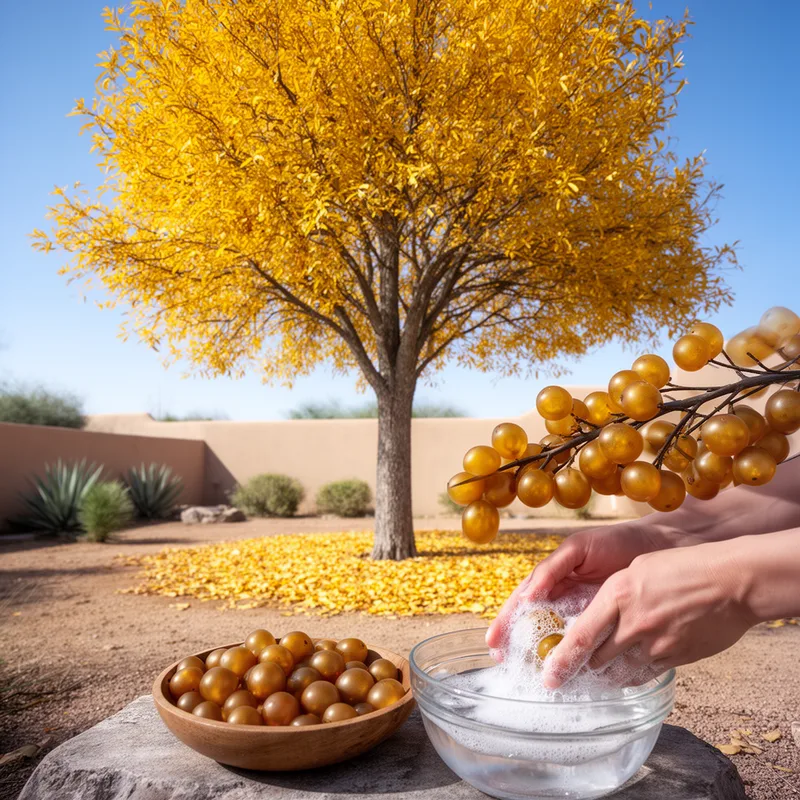
Sapindus marginatus
- noun
- Specialized
- Soap can be made from the saponin-rich fruit of Sapindus marginatus.
Examples
-
Sapindus marginatus is native to the southwestern United States.
-
The leaves of the Sapindus marginatus turn a brilliant yellow in autumn.
-
The Sapindus marginatus is often planted for its ornamental value in gardens.
-
The Sapindus marginatus tree can grow up to 30 feet tall.
-
The fruit of the Sapindus marginatus tree is used to create natural soap.
-
Many people admire the Sapindus marginatus for its beautiful flowers in spring.
-
In its natural habitat, the Sapindus marginatus provides food and shelter for local wildlife.
Synonyms
A tree that loses its leaves and has soft fruit used as natural soap

A tree from the southwestern United States that loses its leaves and has pulpy fruit containing a natural soap-like substance
A tree that makes berries used as natural soap
A tree or its fruit from warm countries that people use as natural soap

A tree or shrub that makes berries used as natural soap

A group of trees and shrubs with fruits called soapberries used as natural soap
Surface Forms
Morphology
Sapindus + marginatus
This is a scientific Latin binomial (genus + specific epithet). Even if a learner knows 'Sapindus' as a genus of soapnut trees, the epithet 'marginatus' is not a common English word and does not transparently convey the species' properties (deciduous, pulpy fruit with saponin). The full taxonomic meaning is technical and not derivable from ordinary-word knowledge, so it would be opaque to a B1 learner.
Etymology
Sapindus marginatus comes from words that point to the tree's soap-like fruit and its leaf edges. Sapindus means 'soap' because the fruit makes a soapy foam, and marginatus means 'with an edge' or 'border', so the name helps you remember it is a soap-producing tree with noticeable leaf margins.

