

wild China tree
- noun
- Specialized
- The pulpy fruit of the wild China tree contains natural saponins used in traditional cleaning methods.
Examples
-
The wild China tree is valued for its ability to thrive in arid regions.
-
Farmers sometimes plant the wild China tree as a windbreak on their land.
-
The wild China tree grows well in arid conditions.
-
Many wild China trees can be found in Arizona.
-
Farmers sometimes plant the wild China tree as a windbreak on their land.
-
The wild China tree is valued for its ability to thrive in arid regions.
-
The pulpy fruit of the wild China tree contains natural saponins used in traditional cleaning methods.
Synonyms
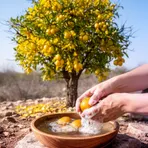
A tree that loses its leaves and has soft fruit used as natural soap

A tree from the southwestern United States that loses its leaves each year and has fruit used to make soap
Surface Forms
Morphology
The components 'wild' and 'tree' give clear clues that this is a kind of untamed tree, so learners will infer its general category. However, 'China' here is part of a lexicalized plant name (and the dictionary entry is missing), so the specific identity and properties (deciduous, pulpy fruit with saponin, native range) are not derivable from the constituents; the name is partially compositional but not fully predictable.
Etymology
Wild China tree may come from a simple image: people found a wild China tree whose soft fruit made soap-like bubbles and was used for cleaning. So today wild China tree refers to a wild tree whose fruit can be used like natural soap.

