

Remembrance Sunday
- noun
- /rɪˈmɛmbrəns ˈsʌndeɪ/
- UK
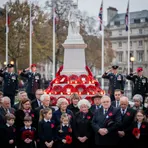
- The Duke said no other politician had ever laid a wreath on Remembrance Sunday as well as Paddy did with his Royal Marine heel click.
Examples
-
The Remembrance Sunday at the Cenotaph was one; HM The Queen's Diamond Jubilee service was another.
Blog text (32) -
Its fame is a principal reason for the British custom of wearing a poppy on Remembrance Sunday.
Academic text (1997) -
Certainly, it is some image of the two thousand English gardens we have created around the world that allows us to repeat each November on Remembrance Sunday, without any false sentiment, some of the most famous verses the Great War inspired.
Academic text (1997) -
Many people attend the Remembrance Sunday service to honor those who lost their lives in the wars.
-
On Remembrance Sunday, the community gathers at the memorial to pay tribute to the fallen soldiers.
-
Each year, the town holds a special ceremony on Remembrance Sunday to remember the sacrifices made during World War I and II.
Synonyms
 1
3.2
1
3.2

A day near November 11 when people remember soldiers who died in war

A Sunday near November 11 when people remember soldiers who died in World War I and World War II
Surface Forms
Morphology
The combination 'remembrance' (an act of honoring) + 'Sunday' (a day) transparently signals a Sunday set aside for remembrance, so learners will likely infer it is a day of commemoration. However, the precise cultural details — that it falls closest to November 11 and specifically commemorates those who died in the World Wars in the UK/Commonwealth — are conventional and not derivable from the words alone, making the expression only partially predictable to a B1 learner.
Etymology
Remembrance Sunday comes from the practice of holding a special Sunday near November 11, the day the fighting stopped in World War I. People wear poppies, lay wreaths and keep a two-minute silence at 11 a.m., so the name—remembrance and Sunday—means a Sunday to 'remember those who died'.