

Remembrance Day
 1
3.2
1
3.2

- noun
- UK
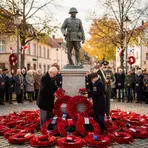
- During the Remembrance Day service, a two-minute silence is observed to remember the fallen.
- Remembrance Day ceremony
Loading YouTube…
Watch on YouTubeI don't know, it's something to do with the two-minute silence and the Muslims wouldn't the Muslims wouldn't recognise that it was our our Remembrance Day.
- I don't know, it's something to do with the two-minute silence and the Muslims wouldn't the Muslims wouldn't recognise that it was our our Remembrance Day.
Examples
-
The Remembrance Day ceremony should be conducted so as to bridge sorrow and joy, grief and celebration.
Academic text (1997) -
On this day, the solemn ceremony will be conducted and attended by all teachers and pupils, starting at 8 a.m. when the Remembrance Day siren is heard.
Academic text (1997) -
Heather and Mike, today is Remembrance Day in Canada.
Blog text (5) -
As you celebrate Veterans Day or Remembrance Day, keep them in mind.
Blog text (33) -
The following is a concise description of one Remembrance Day ceremony.
Academic text (1997) -
We also celebrate Remembrance Day here in Aus, but we have Anzac Day in April as well.
Blog text (4) -
Then a young girl detached herself from the choir and recited a short prose piece regarding the significance of Remembrance Day.
Academic text (1997) -
On Remembrance Day, people gather to honor those who lost their lives in the wars.
-
Schools often hold special activities on Remembrance Day to teach students about the sacrifices made by soldiers.
Synonyms
 2
3.9
2
3.9
A day on November 11 that remembers soldiers who died in World War I

Sunday closest to November 11 when people in the UK and some other countries remember those who died in wars

A Sunday near November 11 when people remember soldiers who died in World War I and World War II
Surface Forms
Morphology
The phrase combines 'remembrance' (an act or token of honoring) and 'day' (a day set aside), so a B1 learner who knows both words can infer it is a day for remembering or honoring people. Specific details like the exact date and its military/UK Commonwealth associations are cultural knowledge, but the core meaning is compositionally transparent.
Etymology
Remembrance Day takes its name from the end of World War I on 11 November 1918, when people first held ceremonies at the moment the fighting stopped to remember soldiers who had died. The red poppy that grew on the battlefields became a symbol, so people wear poppies and keep a two-minute silence to 'remember' the dead, which is why the day honors those who died in war.