
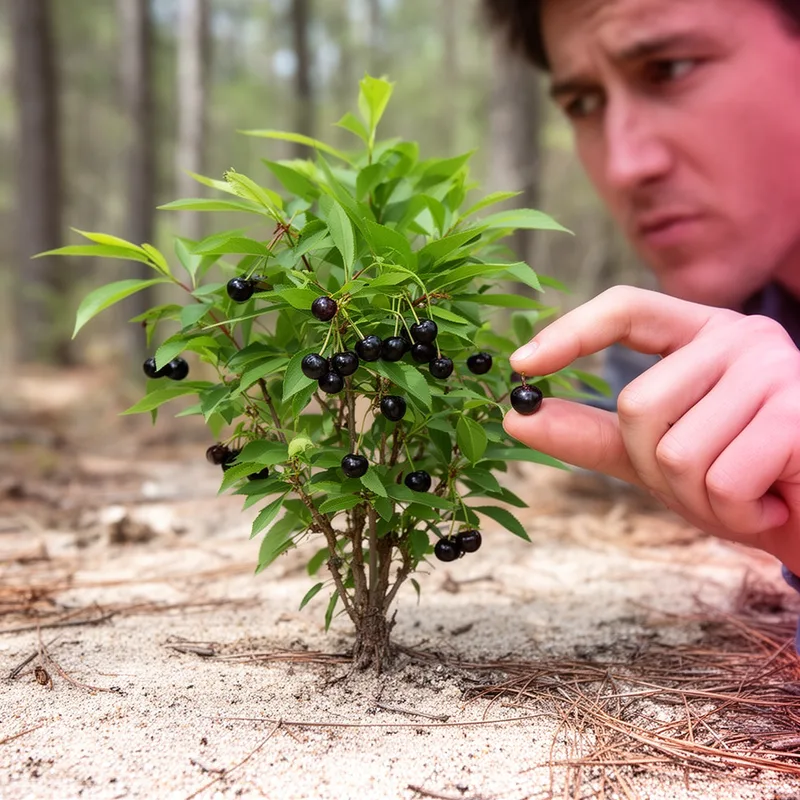
Prunus susquehanae
- noun
- Specialized
- The Prunus susquehanae produces small, purplish-black fruits that are not very edible.
Examples
-
The Prunus susquehanae can often be found growing wild in sandy woodlands.
-
Botanists study the Prunus susquehanae for its unique adaptation to poor soils.
-
The fruit of the Prunus susquehanae is rarely consumed due to its bitter taste.
-
I saw a Prunus susquehanae growing near the riverbank.
-
The Prunus susquehanae thrives in sandy soil.
-
In sandy regions, the Prunus susquehanae is commonly found due to its adaptability.
-
Due to its unique features, the Prunus susquehanae is a subject of interest for many botanists.
Synonyms

A small shrub in North America that grows in sandy soil and has small dark fruit not good to eat

A low North American bush in the cherry family that grows on sandy ground and makes small dark sour fruit
A small wild cherry tree that grows on sandy soil and has tiny dark bitter fruits

A small spreading American cherry that grows on sandy ground and has tiny sour dark fruit
Surface Forms
Morphology
Prunus + susquehanae
This is a Latin binomial: 'Prunus' clearly denotes the genus of trees/shrubs (so a learner who knows that would infer it is a cherry/tree), but 'susquehanae' is a Latinized specific epithet (likely a place or proper name) and is not an ordinary English word providing descriptive meaning. Because part of the name signals the plant genus but the specific epithet gives no transparent descriptive information, the overall expression is only partially predictable to a B1 learner.
Etymology
Prunus susquehanae uses Latin naming: Prunus means 'cherry' and susquehanae means 'of Susquehanna', the river or area where the plant was first found. So the name is a simple memory hook — it tells us this is a small wild cherry from the Susquehanna region with tiny, bitter fruit.

