

Prunus pumilla susquehanae
- noun
- Specialized
- The Prunus pumilla susquehanae is often found in sandy soils along lake shores and dunes.
Examples
-
The fruit of the Prunus pumilla susquehanae is rarely consumed due to its sour taste and small size.
-
Many gardeners appreciate the Prunus pumilla susquehanae for its unique appearance.
-
Botanists study the Prunus pumilla susquehanae for its unique adaptation to harsh environments.
-
The Prunus pumilla susquehanae thrives in sandy soils.
-
The Prunus pumilla susquehanae produces small, nearly inedible purplish-black fruit that wildlife often ignores.
-
In sandy soils, the Prunus pumilla susquehanae can spread out widely, creating a sprawling appearance.
-
Gardeners might plant the Prunus pumilla susquehanae for its unique form, rather than for its fruit.
Synonyms

A small wild cherry that grows on sandy soil with tiny bitter dark fruit

A low North American bush in the cherry family that grows on sandy ground and makes small dark sour fruit

A small shrub in North America that grows in sandy soil and has small dark fruit not good to eat
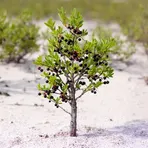
A small wild cherry tree that grows on sandy soil and has tiny dark bitter fruits
How Edible

- Specialized
Surface Forms
Morphology
Prunus + pumilla + susquehanae
This is a Latin scientific binomial: although 'Prunus' signals the genus (cherries), the epithets 'pumilla' and 'susquehanae' are Latinized taxonomic labels, not ordinary English words with transparent meanings. Scientific names function as arbitrary identifiers rather than compositional descriptive phrases, so a B1 learner who knows the parts would not be able to derive the plant description from them.
Etymology
Prunus pumilla susquehanae comes from Latin words: Prunus means 'cherry', pumilla means 'small', and susquehanae points to the Susquehanna area. So the name paints a picture of a 'small cherry from the Susquehanna', which fits this tiny, spreading American cherry that grows on sandy shores.

