
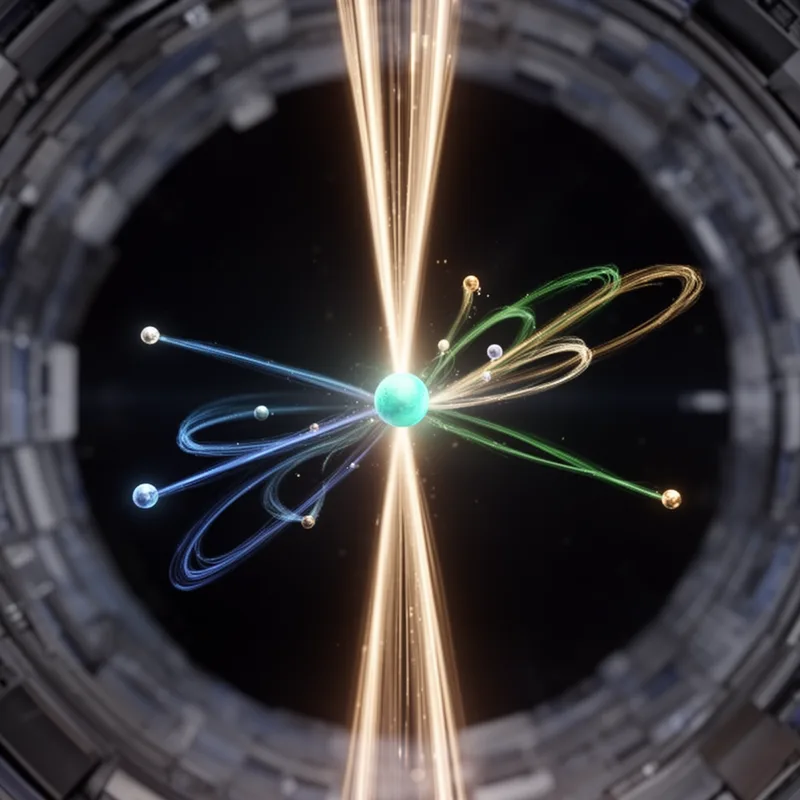
K particle
- noun
- Specialized
 :
partícula K
:
partícula K
- Scientists study K particles to understand fundamental forces.
Examples
-
The presence of a K particle confirms the high-energy conditions of the collision.
-
Scientists observed a K particle decaying rapidly in their experiment.
-
Physicists study K particles to learn more about the fundamental forces in nature.
-
The K particle is a fascinating subject in particle physics.
-
Scientists observed a K particle decaying rapidly in their experiment.
-
Physicists study K particles to learn more about the fundamental forces in nature.
-
The presence of a K particle confirms the high-energy conditions of the collision.
Synonyms


 1
9.9
1
9.9
A particle made when tiny particles hit each other very fast that lasts a short time

A tiny particle made when particles hit each other very fast that breaks into smaller particles
Surface Forms
Morphology
K + particle
The noun 'particle' makes the general category clear so a learner would infer this is some kind of particle, but the 'K' element is an arbitrary letter/symbol whose link to the specific meson (kaon) and its properties is domain-specific and not derivable by a B1 learner. Because the category is transparent but the identifying label requires specialist knowledge, the item is only partially transparent.
Etymology
K particle gets its name from a short label scientists use for a tiny, unstable particle. Imagine the letter K quickly falling apart — or 'decaying' — into smaller pieces after a strong collision; that's why the term means a particle made in high-energy collisions that soon breaks into other particles.