

kaon


 1
9.9
1
9.9
- noun
- /ˈkeɪɒn/
- Specialized
- The CKM (Charged Kaons at the Main Injector) experiment, which was to be built in time to start studying rare kaon decays with a high-flux K+ beam from a fixed target at the main injector when Run II ends in 2009.
- kaon decay
Examples
-
The scattered neutrons were not seen, but their momenta could be deduced from the known photon and kaon momenta.
Academic text (2003) -
The momenta and identities of the kaons were determined by time-of-flight counters and tracking chambers in a magnetic field.
Academic text (2003) -
"Tau" did have an older, already obsolete meaning in connection with kaon decay.
Academic text (1995) -
By measuring an ultrarare kaon decay, the experiment would provide an extraordinarily sensitive probe for new physics beyond the standard model.
Academic text (2003) -
Another purpose of the main injector was to let the collider run simultaneously with fixed-target neutrino and kaon-beam experiments.
Academic text (2003) -
Hall C has one short spectrometer for short-lived particles such as kaons and a large, high-energy one for the electron; most of it is still empty floor space.
Academic text (1993) -
For fermionic matter, the radius is inversely proportional to mass, while for kaon-dominated stellar cores, the proportionality is direct.
Academic text (1995) -
The physicists observed a rare kaon decay, which may provide insights into fundamental forces.
-
In high-energy experiments, scientists often create kaons by smashing protons together.
-
Researchers are studying kaons to understand better the strong interaction between quarks.
Synonyms

A tiny particle made when particles hit each other very fast that breaks into smaller particles
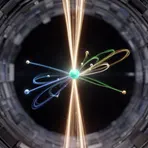
A tiny particle smaller than an atom that breaks into other particles after high-energy collisions
Surface Forms
Morphology
Etymology
Kaon comes from the name 'K meson': scientists used the letter K to label this particle, and the ending -on is the same as in pion and electron, which marks 'a particle'. So a kaon is simply the 'K' particle, a kind of meson often made in high-energy collisions.