
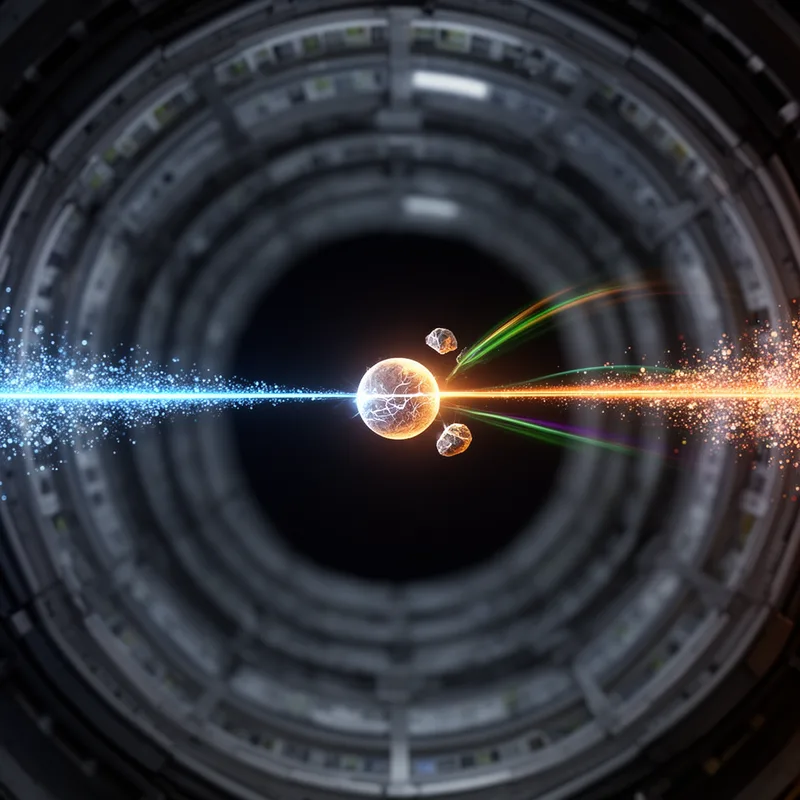
k-meson
- noun
- Specialized
- Physicists observed the decay of a k-meson in the laboratory after a particle collision.
Examples
-
Many experiments at the accelerator focus on producing and detecting k-mesons.
-
Scientists study k-mesons to understand particle interactions.
-
The discovery of the k-meson provided new insights into the behavior of subatomic particles.
-
The k-meson is a fascinating particle in physics.
-
Physicists observed the decay of a k-meson in the laboratory during a high-energy collision.
-
Many experiments at the accelerator focus on producing and detecting k-mesons for particle physics research.
-
Scientists study k-mesons to gain insights into the fundamental forces governing particle interactions.
Synonyms


 1
9.9
1
9.9
A particle made when tiny particles hit each other very fast that lasts a short time
A tiny particle smaller than an atom that breaks into other particles after high-energy collisions
Surface Forms
Morphology
Etymology
The word k-meson (also called kaon) comes from the letter K, which was used to name the particle, plus the common particle ending -on, as in proton and electron. So the name simply tells you it is the 'K' particle, a short-lived particle made in high-energy collisions that quickly breaks apart.