
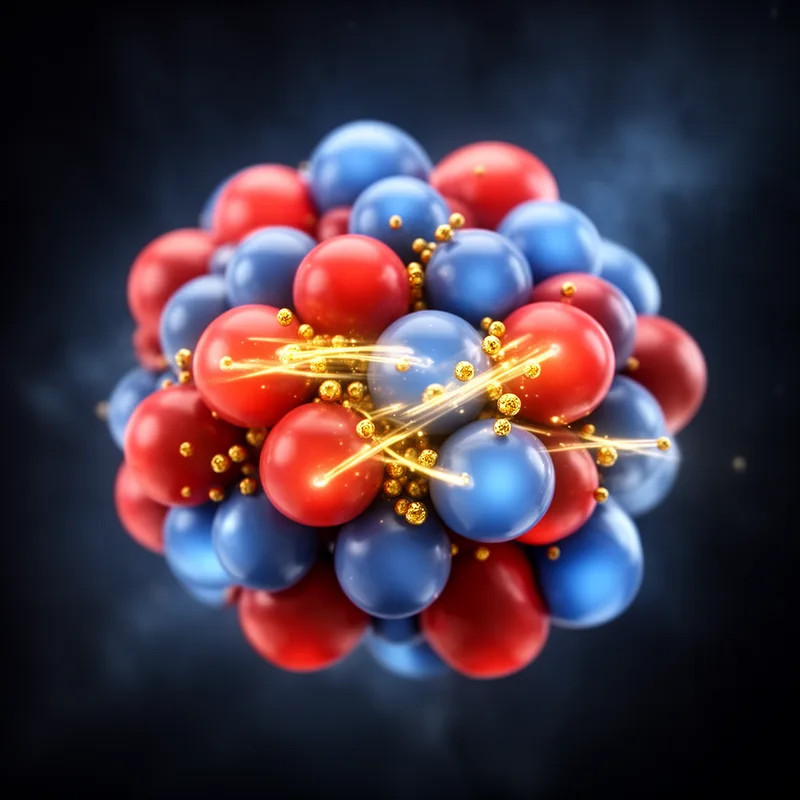
meson
 5
9.9
5
9.9

- noun
- /ˈmɛzɒn/
- Specialized
- Physicists study the properties of various types of meson, which help us understand the strong force in the nucleus.
- mesons and baryons
- B-meson
- pi mesons
Loading YouTube…
Watch on YouTubeHadrons are subnuclear particles, protons, neutrons, mesons.
- Hadrons are subnuclear particles, protons, neutrons, mesons.
- And you see all these particles scattering up things like quarks and, and gluons and mesons and so forth.
Examples
-
In particular, they measured the production of the J/? meson—the bound state of the charmed quark and its antiquark.
Academic text (2003) -
Other heavy particles, such as neutrons, light ions (particularly carbon and neon), and pi mesons have also been used for radiation therapy.
Academic text (2002) -
It could be a heavy meson, let me just call it H.
-
In the top panel, the tagged meson is a "B 0."
Blog text (33) -
But its observed strong decay to a neutron plus a K+ meson marks it as something radically new.
Academic text (2003) -
Some years later, the particles that did not produce showers were identified as mesons, and the evidence for a breakdown of QED disappeared.
Academic text (2005) -
Like we can't make a quark, but we can make mesons that have quarks in them.
Blog text (3) -
They had to do with protons, neutrons, mesons, particularly mesons.
-
Proton, electron, neutron, these mesons which exchange the force between the neutrons and protons.
-
When high-energy cosmic-ray protons and nuclei hit the atmosphere, they generate showers of mesons that quickly decay to muons, electrons, positrons, and neutrinos.
Academic text (1998)
Synonyms
An old name for a tiny particle that helps hold the center of an atom together
Compounds

- Specialized
A tiny particle made of a bottom quark and another quark that exists for a very short time

- Specialized
A tiny particle made when particles hit each other very fast that breaks into smaller particles

- Archaic
An extremely small particle with negative charge that lasts about two microseconds and becomes an electron and two neutrinos
- Specialized
A very small unstable particle made when particles hit each other at high speed
How Composite

Surface Forms
Morphology
meson = meso (opaque) = meso + on
The combining form 'meso-' is a technical combining form and the scientific sense of 'meson' is specialized, so an average B1 learner cannot reliably infer the physics meaning from its parts.
Etymology
The word meson comes from the Greek mesos meaning 'middle' and the scientific ending -on, as in electron and proton. It was named because mesons have a mass between electrons and protons and act as 'middle' particles that help hold the center of the atom together, so the name fits their role.