
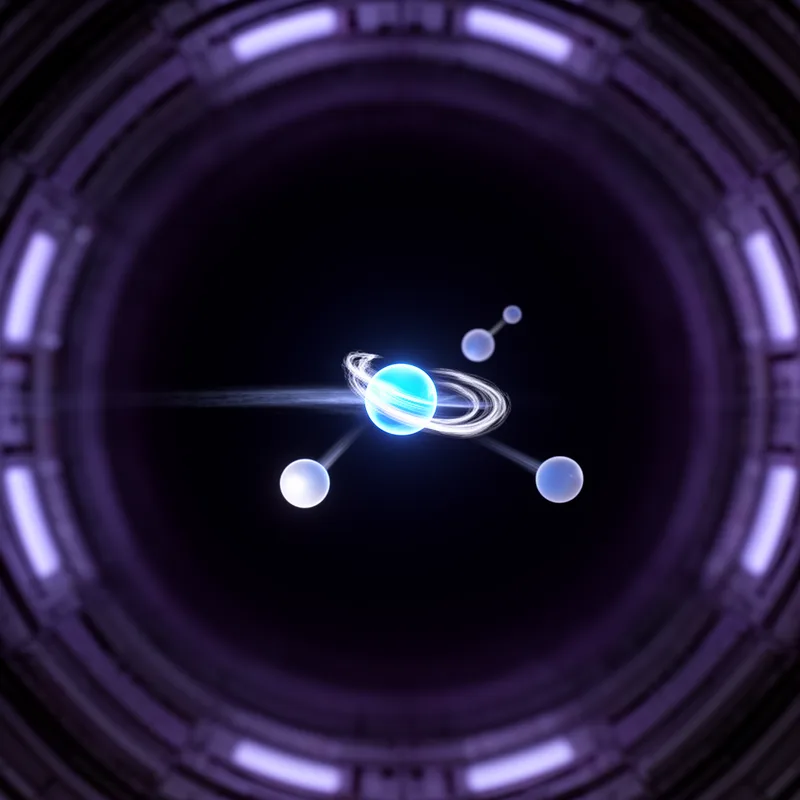
mu-meson
- noun
- /ˈmjuːˌmɛsɒn/
- Archaic
 :
muón
:
muón
- A mu-meson decays rapidly into an electron and two neutrinos, which makes it an important subject in particle physics.
Examples
-
Due to its short half-life, a mu-meson exists for only about 2 microseconds before decaying.
-
A mu-meson is unstable and decays quickly after being produced in cosmic rays.
-
Scientists initially classified the mu-meson as a type of meson before realizing its distinct properties.
-
The discovery of the mu-meson contributed significantly to our understanding of particle physics.
-
The mu-meson is a type of elementary particle.
-
Scientists study mu-mesons to understand particle decay.
-
Researchers use particle accelerators to create mu-mesons for experiments in high-energy physics.
Synonyms

 5
9.9
5
9.9

A small particle like an electron but much heavier and lasting only a very short time
A tiny charged particle that lasts about 2 microseconds and becomes an electron and two neutrinos
Surface Forms
Etymology
The word mu-meson gets its name from the Greek letter mu and the word meson, from Greek mesos meaning 'middle'. Early scientists thought it was a 'middle' particle between very small electrons and much heavier particles, so the name helps you remember it is a tiny particle in physics.