
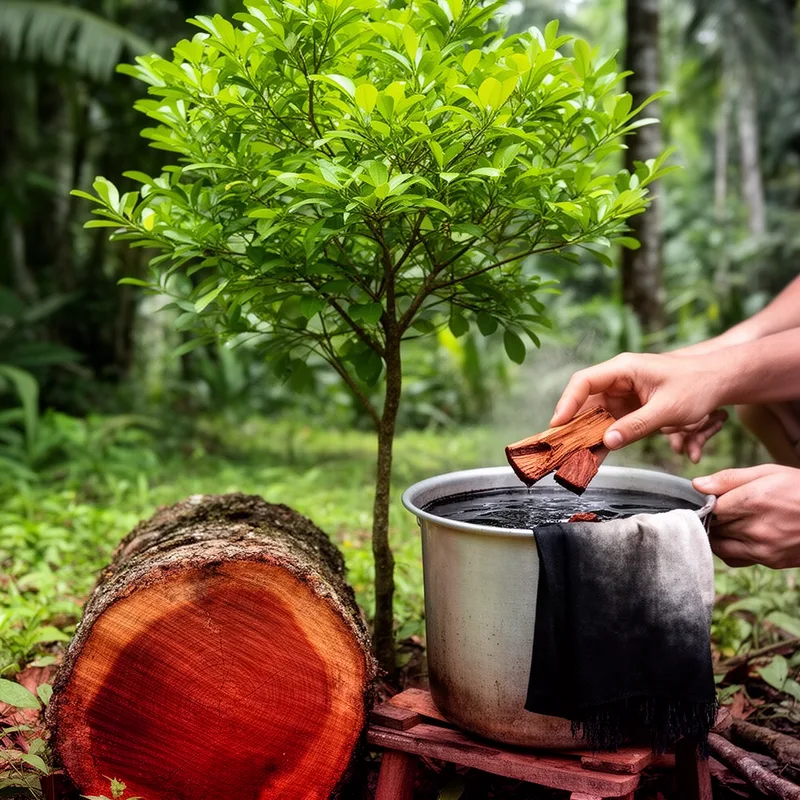
Haematoxylum campechianum
- noun
- /ˌhiːməˈtɒksɪləm kæmˌpeɪkiˈænəm/
- Specialized
- Early settlers prized Haematoxylum campechianum for its valuable heartwood, which produced a deep black dye.
Examples
-
The dye extracted from Haematoxylum campechianum was once widely used in the textile industry.
-
Botanists studied the growth patterns of Haematoxylum campechianum in the forests of Central America.
-
The Haematoxylum campechianum tree is known for its beautiful yellow flowers.
-
Many artisans use Haematoxylum campechianum for dyeing fabrics.
-
Many artisans rely on Haematoxylum campechianum to create a rich black dye for their textiles.
-
The heartwood of Haematoxylum campechianum is sought after for its ability to produce a deep, vibrant dye.
-
In traditional crafts, Haematoxylum campechianum is used extensively for dyeing various fabric types.
Synonyms

A small spiny tree from Central America and the Caribbean that people use to make dark dye
A small spiny tree from the Caribbean whose hard inner wood makes black dye
A spiny shrub of Central America and the Caribbean with yellow flowers and hard inner wood for black dye

A small spiny tree with bright yellow flowers used to make black dye
Surface Forms
Morphology
Haematoxylum + campechianum
Haematoxylum campechianum is a Latin binomial proper name rather than a compositional English phrase, so it functions as a label for a particular species (logwood) rather than a phrase whose meaning is built transparently from its parts. The second element is a Latinized epithet (campechianum) and the first element is technical botanical terminology; these are not productive, everyday English words a B1 learner would use to infer the full meaning, making the expression non-derivable from its constituents.
Etymology
The name Haematoxylum campechianum comes from old words haemato- meaning 'blood' and -xylum meaning 'wood', because the tree's red inner wood gives a deep dye, and 'campechianum' shows it comes from Campeche. So the name means 'blood wood from Campeche' and reminds us of its dye use.

