
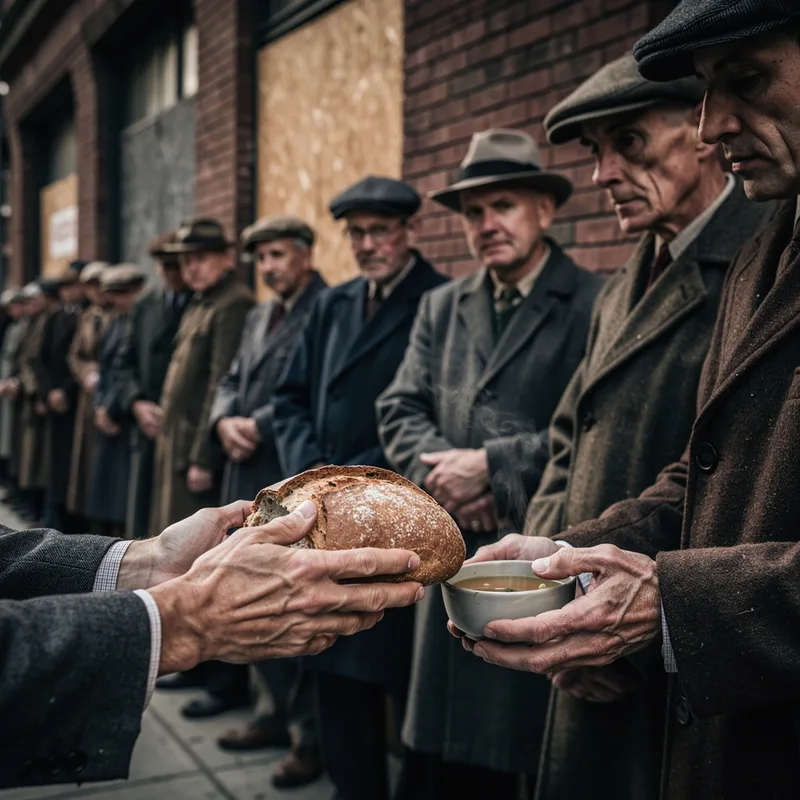
Great Depression
 78
4.0
78
4.0

- noun
- /ɡreɪt dɪˈprɛʃən/
- By comparison, during four years of the Great Depression, the United States lost 29 percent of its GDP.
- the Great Depression of the 1930s
- the Great Depression of 1929
- causes of the Great Depression
Loading YouTube…
Watch on YouTubeAnd that was kind of in the Great Depression.
- And that was kind of in the Great Depression.
- Also, in my first macroeconomics class, I studied the Great Depression and business cycles more generally.
- It was in the wake of the worst crisis since the Great Depression.
- We're coming out of this Great Recession, the worst since the Great Depression.
- The world, the likes of which the world has not seen since the Great Depression.
- Quite often these these pundits will point to historical antecedents such as the Great Depression.
- So the great power conflict, that also is the most that that's happened since the the Great Depression.
Examples
-
GAGE: During the years of the Great Depression, many families left their homes to seek work.
-
With the onset of the Great Depression, Jesse found working the farm increasingly difficult.
Academic text (1990) -
Then it was hit with a Great Depression, which hit Germany even worse than hit the United States.
-
- Was she born during the Great Depression?
-
Even though the Great Depression was in full swing around the world... ...it still seemed far away from the world I knew.
-
Narrator 1: During the Great Depression, times were hard for most Americans.
Fiction book (1999) -
Homelessness on a scale unknown since the Great Depression was about to become the norm for millions.
Academic text (1992) -
Also, in my first macroeconomics class, I studied the Great Depression and business cycles more generally.
-
After all, Europeans of all political persuasions experienced the Great Depression of the 1930s, whether under democracy or not.
Academic text (1997) -
During the Great Depression, millions of people lost their jobs and struggled to find food.
Synonyms
 222
3.9
222
3.9
A severe worldwide economic decline in the 1930s that caused high unemployment
How Severe
78
4.0

- Specialized
39
4.0
63
3.7
- Specialized
858
4.6
53
3.7
Surface Forms
Morphology
The phrase is largely compositional: 'great' (major) + 'depression' (a severe economic downturn) yields the core meaning 'a very severe economic downturn,' which a B1 learner who knows both words can infer. However, the specific historical referent (the 1930s worldwide crisis) and the status as a named historical event are not predictable from the constituents alone, so full understanding requires extra cultural/historical knowledge.
Etymology
Great Depression comes from a simple image: Great means very big and Depression once meant a low place or hollow in the ground. People used that picture to show the economy had fallen into a very big 'low' with many people losing jobs, so the phrase came to mean a very large 'economic crisis'.