

French polish
- noun
- /frɛntʃ ˈpɒlɪʃ/
- Specialized
- He applied several coats of French polish to achieve a deep, glossy surface on the wooden cabinet.
Examples
-
The antique table was restored carefully using French polish to bring out its shine.
-
Traditional furniture makers often use French polish to give wooden pieces a luxurious finish.
-
The antique table was finished with French polish.
-
He applied French polish carefully to the wood.
-
He applied several coats of French polish to achieve a deep, glossy surface on the wooden cabinet.
-
Traditional furniture makers often use French polish to give wooden pieces a luxurious finish.
-
The antique table was restored carefully using French polish to bring out its shine.
Synonyms

 81
2.7
81
2.7

A substance used to make a surface smooth and shiny
 12
4.4
12
4.4
A clear hard shiny layer put on wood to protect it and make it shine
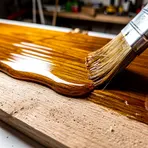 11
6.5
11
6.5
A hard shiny coating that protects and decorates things like wood and metal
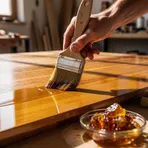 4
7.4
4
7.4
A natural hard substance used to make a shiny protective coat on wood or furniture

A shiny wood finish you make by mixing shellac with alcohol
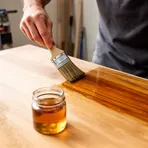
A thin clear or colored coating made from shellac and alcohol to protect and shine wood

A very shiny smooth surface that reflects light brightly
How Shiny

Surface Forms
Morphology
The noun 'polish' clearly denotes a substance or finish used to make surfaces shiny, and the attributive adjective 'French' signals origin or style, so a learner can infer this is a particular kind or style of polish/finish. The specific materials (shellac and alcohol) are technical details, but the basic meaning 'a type of polish/high-gloss finish' is directly derivable from the constituents and common cross-linguistic adjective+noun composition.
Etymology
French polish comes from a way of working used by French furniture makers, who rubbed many thin layers of shellac with a soft pad to polish wood until it shone like a mirror. That's why French polish means 'a high-gloss finish' on wood made by this rubbing method.