
Cultural Revolution
 11
7.9
11
7.9

- noun
- /ˈkʌltʃərəl ˌrɛvəˈluːʃən/
- The coercive policies of the Cultural Revolution had indeed promoted women's educational opportunities.
- the Great Proletarian Cultural Revolution
- Cultural Revolution in China
- end of the Cultural Revolution
Loading YouTube…
Watch on YouTubeHis mother was a school teacher and Lew was growing up during the Cultural Revolution.
- His mother was a school teacher and Lew was growing up during the Cultural Revolution.
- Before then, China was a poor country caught in the throes of a cultural revolution where maybe a million Chinese died.
- They were never taught the history of communism and the history of Chinese communism and the history of the Chinese Cultural Revolution.
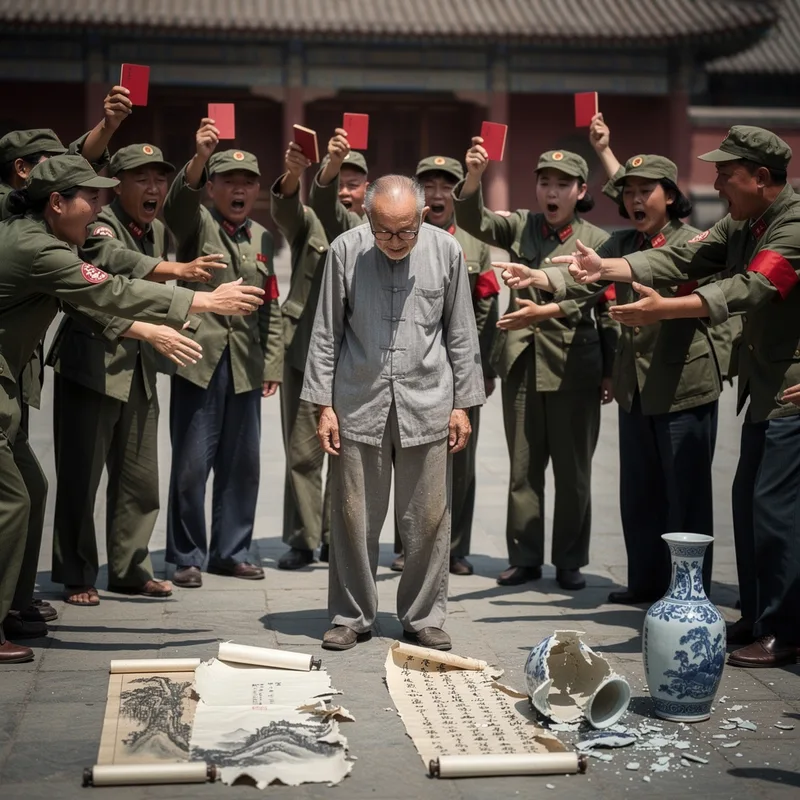
- People start to Google struggle sessions under mouse cultural revolution.
- Whiteness is the same in today's Cultural Revolution theater.
- He was himself in the Cultural Revolution, in times treated brutally.
- We know about Chinese Mao Zedong, Cultural Revolution, quite a crazy time here being known national socialism in Germany.
Examples
-
Also, China's position in the world has changed dramatically since the Cultural Revolution and even since the 1989 demonstrations.
Academic text (1997) -
The vast monastic system was also dismantled, and during the Cultural Revolution, all religious activities were prohibited.
Academic text (1998) -
The current generation of college students grew up after the Cultural Revolution.
Academic text (2002) -
The Gang of Four was arrested, effectively marking the end of the Cultural Revolution.
Academic text (1999) -
The detrimental effect of the Cultural Revolution is clearly shown in these statistics.
Academic text (1996) -
In high school, Michael had learned about Sun Yat-sen, the Japanese invasion, and the Cultural Revolution.
Fiction book (1991) -
Books, movies, and music banned during the Cultural Revolution began to resurface.
Academic text (1999) -
Most are also survivors of domestic upheavals such as the Cultural Revolution.
Academic text (1999) -
With the abandonment of collectivization at the end of the Cultural Revolution, a power vacuum emerged in the countryside.
Academic text (2008) -
During the Cultural Revolution, many people lost their jobs and were persecuted for their beliefs.
Synonyms


 1
9.9
1
9.9
A mass political movement led by Mao in China from 1966 to 1976 that attacks intellectuals and causes widespread violence
Surface Forms
Morphology
The compound 'Cultural Revolution' transparently combines 'cultural' (relating to society's customs and arts) and 'revolution' (a major, rapid change), so a B1 learner who knows both words can infer it denotes a major upheaval affecting culture. However, the full meaning refers to a specific historical political movement in China with particular goals, actors, dates, and consequences that are not predictable from the constituents alone, so the term is only partially transparent.
Etymology
Cultural Revolution is the name for the 1966–1976 movement in China when leaders tried to force a sudden change in people's culture, attacking old schools, books, and art. The word Revolution means a big, often violent change and Cultural refers to customs and beliefs, so the name shows it was a campaign 'to remove old customs and make new ones'.