
Great Proletarian Cultural Revolution


 1
9.9
1
9.9
- noun
- The Great Proletarian Cultural Revolution aimed to eliminate traditional and capitalist influences in China.
Examples
-
China, of course, had long experience under Mao Zedong with punishing the rich for their sins, such as the Great Leap Forward (1958-1961) and the Great Proletarian Cultural Revolution (1965-71).
Blog text (24) -
For example, only the Western academic community of professional "China watchers" sang the praises of Mao and his Great Proletarian Cultural Revolution during the 1960s.
Academic text (1992) -
The sad experience of the Great Proletarian Cultural Revolution has caused China to lose more than 50 percent of its young educational resources.
Academic text (1996) -
On such grounding, we welcomed the theory and practice of the Great Proletarian Cultural Revolution.
Blog text (9) -
The new Maoist tradition changed some of these values, especially during such periods as "the Great Proletarian Cultural Revolution," when families and communities were divided by political differences.
Academic text (1992) -
The brutal image of Mao Zedong and his "great proletarian cultural revolution" faded away after his death and the downfall of "the gang of four."
Academic text (1992) -
The most chaotic time in recent years was 1967, the height of China's Great Proletarian Cultural Revolution, when the degree of unrest, political turmoil, and irrational behavior exceeded anything that has occurred, perhaps, in modern history.
Academic text (1990) -
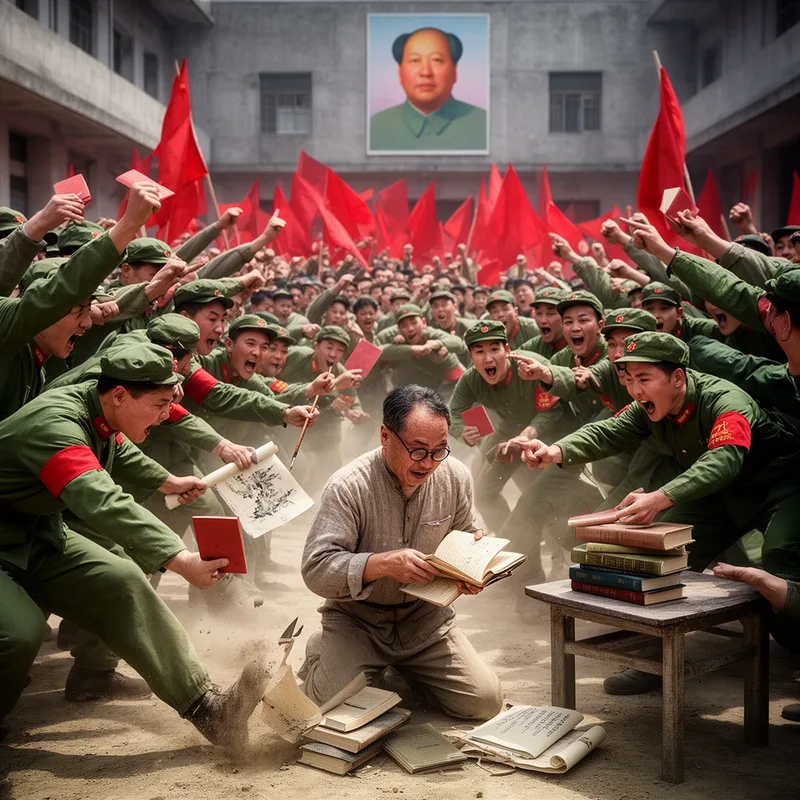
During the Great Proletarian Cultural Revolution, many intellectuals faced persecution and public humiliation.
-
The chaotic events of the Great Proletarian Cultural Revolution resulted in significant social upheaval across China.
Synonyms
 11
7.9
11
7.9
A political movement in China that removed old ideas and punished many educated people
Surface Forms
Morphology
great + proletarian + cultural + revolution
Knowing the constituents lets a learner infer this is a major (great) working-class (proletarian) movement to transform society’s culture (cultural revolution), so the broad concept is partially recoverable from the words. However, as a proper-name historical event with specific political aims, time frame, and violent consequences that are not predictable from the components, full meaning and connotations remain opaque without prior exposure.
Etymology
Great Proletarian Cultural Revolution is the name of Mao Zedong's plan for a very large change led by the working people: proletarian means 'workers' and cultural revolution means 'to change the culture'. Imagine young 'Red Guards' with red armbands tearing down old books and sending teachers away — that picture helps explain why the phrase now refers to a radical movement to remove 'old' and 'non-communist' ideas, often with harsh punishments and big social change.