
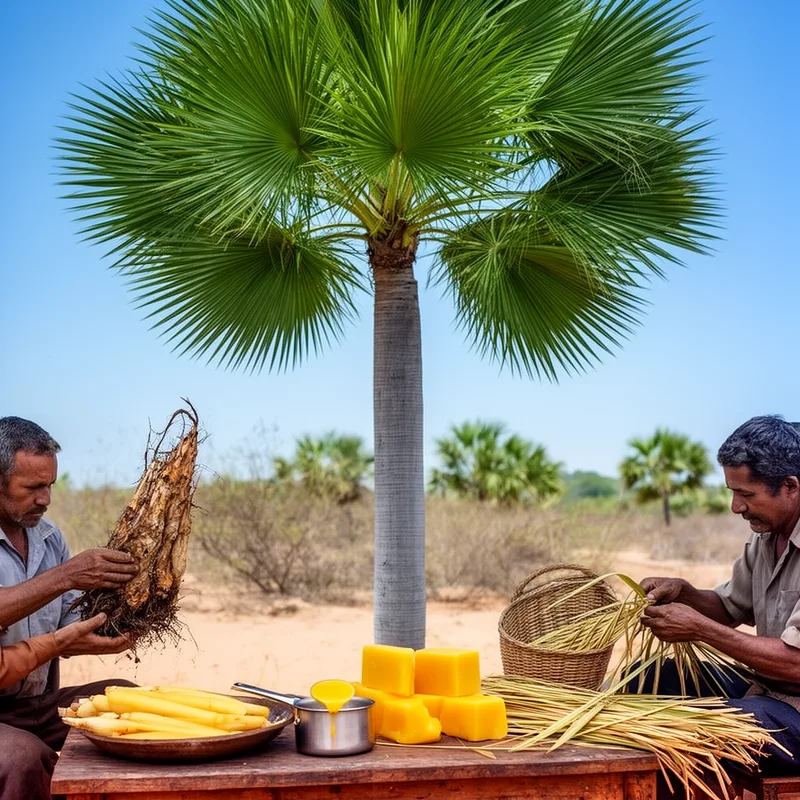
Copernicia prunifera
- noun
- Specialized
- The Copernicia prunifera is cultivated in Brazil for its valuable carnauba wax.
Examples
-
Artisans weave baskets from the tough leaves of the Copernicia prunifera.
-
Scientists are studying the edible roots of Copernicia prunifera for use in nutrition.
-
The Copernicia prunifera is known for its tall trunk.
-
Farmers in Brazil cultivate Copernicia prunifera for its fibers.
-
Artisans weave baskets from the tough leaves of the Copernicia prunifera, prized for its fiber.
-
Scientists study the roots of Copernicia prunifera, which are edible and used in nutrition.
-
The Copernicia prunifera is harvested in Brazil for its carnauba wax, sought after for various products.
Synonyms

A Brazilian fan palm with an edible root used for wax and leaf fiber

A Brazilian palm tree that gives yellow wax and leaf fiber

A Brazilian fan palm that gives edible roots, strong fibers, and hard yellow wax
Surface Forms
Morphology
Copernicia + prunifera
This is a Latin binomial (genus + species) used as a taxonomic label rather than an English compositional phrase; its full meaning ('a Brazilian fan palm with edible root, source of fiber and wax') cannot be derived from the constituent forms. Even if a learner recognized 'Copernicia' as a type of fan palm, the species epithet 'prunifera' is a specialized Latin form (and is not a common English word), so a B1 learner who only knows the parts would not be able to infer the specific botanical properties.
Etymology
Copernicia prunifera may mix a person's name and a Latin picture: Copernicia likely honors the scientist Copernicus, and prunifera comes from Latin roots meaning 'plum-bearing', with pruni 'plum' and fera 'bearing'. So the name helps you remember this Brazilian fan palm as a fruit-bearing plant with a scientific name tied to a real person.

