

carnauba
- noun
- /kɑrˈnɔːbə/
- The leaves of the carnauba palm are harvested to produce a natural wax used in cosmetics and food.
Examples
-
Instead, companies have chosen to occupy the unutilized interspaces between the stands of carnaubas that dot the lower valley.
Academic text (1994) -
Their livelihood as goat herders, small agriculturalists, and carnauba processors all but disappeared.
Academic text (1994) -
In Brazil, the carnauba is often called 'the tree of life' due to its many uses and benefits.
-
The carnauba provides fiber that is used for various crafts and materials in local communities.
Synonyms

A Brazilian fan palm with edible roots and leaves used for fiber and yellow wax
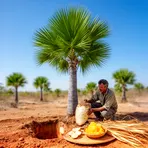
A Brazilian fan palm with an edible root used for wax and leaf fiber
Compounds

Surface Forms
Etymology
Carnauba is the Portuguese name carnaúba, taken from a native Tupi word for a Brazilian palm tree. People call this palm the 'tree of life' because it gives food, strong leaf fiber and a brittle yellowish 'wax', so the plant and its wax share the same name.

