

Copernicia cerifera
- noun
- Specialized
- Copernicia cerifera is cultivated in Brazil for its valuable carnauba wax.
Examples
-
The leaves of Copernicia cerifera supply strong natural fibers used in handicrafts.
-
Researchers are studying the edible root of Copernicia cerifera for its nutritional benefits.
-
The Copernicia cerifera is known for its edible roots.
-
Many artisans use Copernicia cerifera fibers for crafting.
-
Copernicia cerifera is harvested for its carnauba wax, which is often used in cosmetics and food products.
-
The edible roots of Copernicia cerifera are a staple for many communities in Brazil.
-
Artisans create beautiful items using the fibers derived from Copernicia cerifera, showcasing their craftsmanship.
Synonyms

A Brazilian fan palm with edible roots and leaves used for fiber and yellow wax
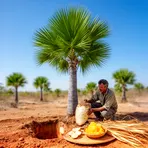
A Brazilian fan palm with an edible root used for wax and leaf fiber

A Brazilian palm tree that gives yellow wax and leaf fiber
Surface Forms
Morphology
Copernicia + cerifera
This is a scientific binomial: knowing 'Copernicia' (a genus of fan palms) lets a learner infer the phrase denotes a type of palm, which is a transparent taxonomic relation common across languages. However, the specific epithet 'cerifera' is not a familiar English word (it requires Latin/botanical knowledge to interpret 'wax-bearing') and the detailed senses in the definition (edible roots, fiber and wax source) are not deducible from the constituents alone, so the overall meaning is only partially predictable.
Etymology
Copernicia cerifera is a two-part Latin name: Copernicia honors the astronomer Copernicus, and cerifera comes from Latin meaning 'wax-bearing'. Because the palm makes a hard yellow 'wax' called carnauba that people collect and use, the name helps you remember this plant for its wax.

