
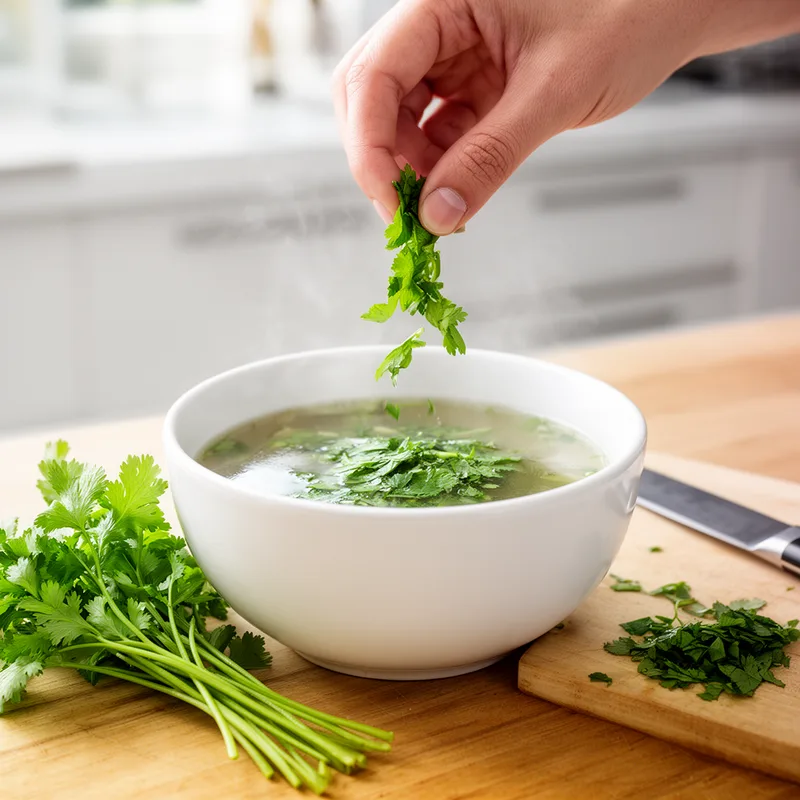
Chinese parsley
- noun
- /ˈtʃaɪniːz ˈpɑːrsli/
- You can find Chinese parsley at most grocery stores, where it is often labeled as cilantro.
- Chinese parsley or cilantro
- Chinese parsley or coriander
- called Chinese parsley
Examples
-
In many recipes, Chinese parsley is used to garnish dishes and add flavor.
-
The recipe calls for a handful of Chinese parsley leaves, also known as coriander.
-
Many Asian dishes use Chinese parsley as a fresh garnish.
-
She sprinkled chopped Chinese parsley over the soup for extra flavor.
-
I love adding Chinese parsley to my salads.
-
What do you think of Chinese parsley as a garnish?
-
When making salsa, adding fresh Chinese parsley enhances the overall taste with its aromatic leaves.
Synonyms

 41
3.5
41
3.5

An herb with fresh green leaves used to add flavor to food, also called coriander
 5
2.8
5
2.8
Fresh green leaves that add flavor to food
An herb with fragrant leaves and small seeds used in cooking, called coriander or cilantro

A small green herb with feathery leaves and seeds used as a spice, also called cilantro
Surface Forms
Morphology
The phrase is compositionally clear in that a learner who knows 'Chinese' and 'parsley' will expect an herb (a parsley-like plant) associated with China, so the general category (an herb/garnish) is predictable. However, the specific identity—that the term refers to coriander/cilantro rather than true parsley—is a lexical naming convention not directly derivable from the parts and varies cross-linguistically, so the exact meaning may not be inferred by a B1 learner.
Etymology
Chinese parsley may come from people who saw the fresh leaves used in Chinese and other Asian cooking and thought they looked like common parsley. So the name joins Chinese because the leaves were often used there and parsley because of their look, and today it means the herb 'coriander' or 'cilantro'.