
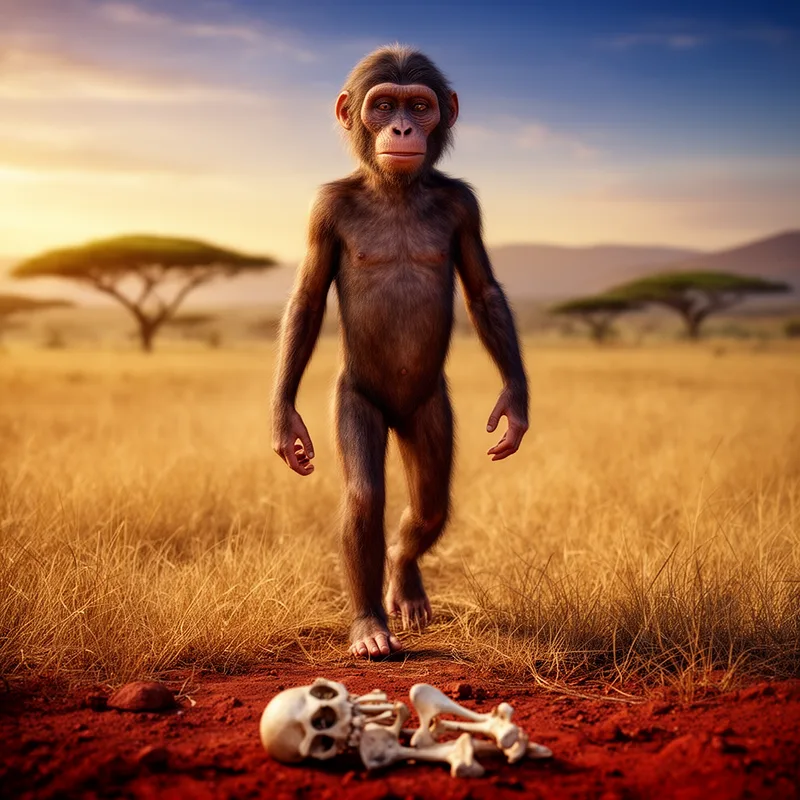
Australopithecus
- noun
- /ˌɔstrəloʊˈpɪθɪkəs/
- Specialized
 :
australopiteco
:
australopiteco
- The famous fossil named 'Lucy' is classified as Australopithecus afarensis.
No, I, I, I was reading a, a really great book about Australopithecus.
- No, I, I, I was reading a, a really great book about Australopithecus.
- We did not descend from Australopithecus, we didn't Lucy, we didn't descend from Neanderthal.
Examples
-
She belongs to a species called Australopithecus afarensis.
-
We look biologically very different from, say, from Lucy, from Australopithecus, from Homo erectus, from all these different species.
-
So his book talks about Australopithecus and, and the move to from apes in trees to upright animals on planes.
-
What you meant was that that entire hominid line didn't make it, because if they did, they'd still be, we'd have Australopithecus living next door.
-
We did not descend from Australopithecus, we didn't Lucy, we didn't descend from Neanderthal.
-
Australopithecus was an important species in the evolution of modern humans.
-
Researchers discovered fossils of Australopithecus that provide insights into our ancestry.
Synonyms
A former scientific name for early human fossils that scientists now treat as Australopithecus

An old scientific name for early humanlike fossils now called Australopithecus
Compounds

- Specialized
An extinct early human ancestor known from fossils found in Ethiopia

- Specialized
An extinct early human ancestor that lived in southern Africa about three million years ago

- Specialized
An early human relative with very large teeth that lived in eastern Africa one to two million years ago

- Specialized
An extinct early human relative with large teeth that lived in southern Africa around two million years ago
Surface Forms
Morphology
Australopithecus = austral + pithecus
A specialized taxonomic compound formed from learned combining forms ('austral-' + '-pithecus') whose parts are not productive or familiar to average learners, so the meaning is not derivable by typical B1 users.
Etymology
Australopithecus is made of two parts: australis 'southern' and pithekos 'ape', so it literally means 'southern ape'. That's a handy memory hook because these extinct, early human-like apes were found in southern Africa, so the name connects to what they were and where they lived.

