
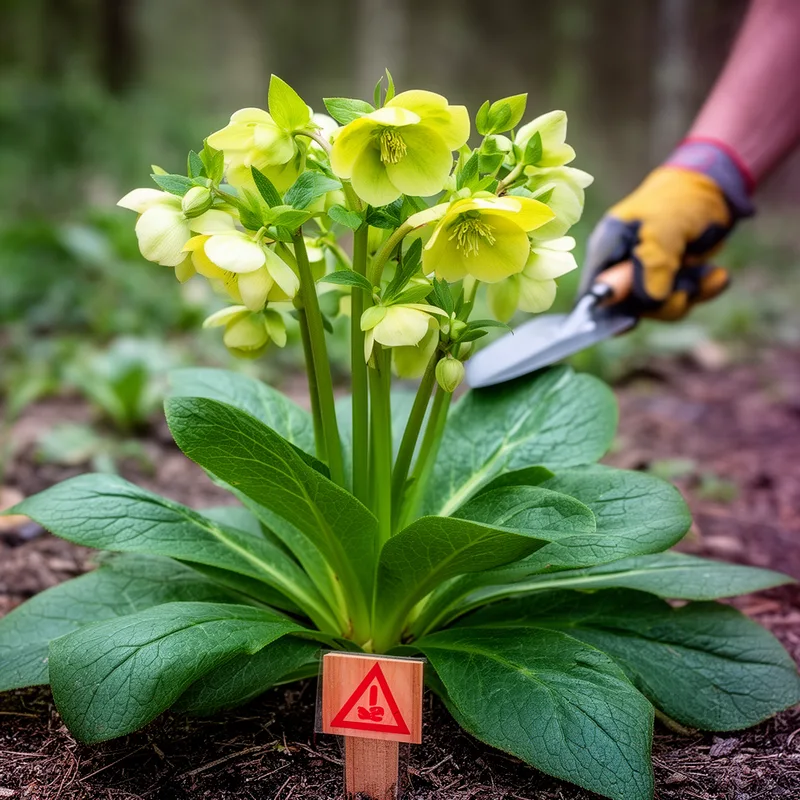
white hellebore
- noun
- /ˈhwaɪt ˈhɛlɪbɔr/
- Specialized
- The roots of white hellebore have been used in traditional medicine, despite their toxicity.
Examples
-
Gardeners should handle white hellebore with care because of its poisonous alkaloids.
-
The distinctive yellow-green flowers make white hellebore easy to identify in the wild.
-
The white hellebore is known for its toxicity.
-
Many gardeners admire the white hellebore for its unique flowers.
-
Gardeners should handle white hellebore with care because of its poisonous alkaloids.
-
The roots of white hellebore have been used in traditional medicine, despite their toxicity.
-
The distinctive yellow-green flowers make white hellebore easy to identify in the wild.
Synonyms

A North American plant with large green leaves and yellow-green flowers that contains poisonous chemicals used in some medicines
A North American plant with large leaves and greenish flower clusters that is poisonous and used carefully in medicine

A poisonous plant with large leaves and greenish yellow flower clusters that people use in traditional medicine

A wild plant like a lily that grows every year with large leaves and thick poisonous roots
Surface Forms
Morphology
The phrase is a straightforward adjective + noun composition: 'white' specifies the colour/variant of 'hellebore' (a plant genus). There is no idiomatic or metaphorical shift—learners who know both constituent meanings will infer it denotes a hellebore that is white or pale, a pattern common across languages.
Etymology
White hellebore may come from the old plant name hellebore, a word people long used for a strong, often dangerous root, and the word white was added because parts of the plant look pale. So the name shows a pale plant that is both 'poisonous' and used as 'medicine'.

