
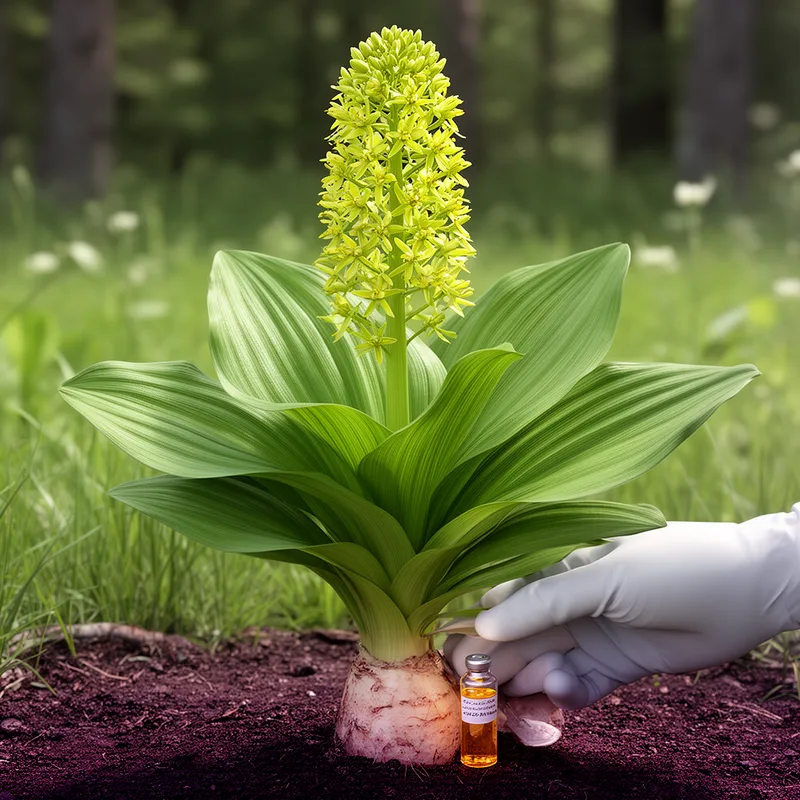
Veratrum viride
- noun
- /ˈvɛrətrum ˈvaɪraɪd/
- Specialized
- The roots of Veratrum viride have been used in traditional medicine, but they are highly toxic.
Examples
-
Botanists studied the flower structure of Veratrum viride in its native habitat.
-
In the spring, Veratrum viride blooms with striking yellowish-green flowers that attract pollinators.
-
Veratrum viride should be handled with care due to the dangerous alkaloids it contains.
-
The Veratrum viride is often found in wet meadows.
-
Farmers should be cautious of Veratrum viride in their fields.
-
The roots of Veratrum viride produce a toxic alkaloid that has been traditionally used in medicine.
-
Due to its toxicity, Veratrum viride should not be ingested without proper medical supervision.
Synonyms
A North American plant with large leaves and greenish flower clusters that is poisonous and used carefully in medicine

A poisonous plant with large leaves and greenish yellow flower clusters that people use in traditional medicine

A North American plant with large leaves and yellow-green flowers that is poisonous
A North American plant with large leaves that has chemicals used in medicine but can be poisonous
Surface Forms
Morphology
Veratrum + viride
This is a scientific Latin binomial (genus + species epithet) so, in principle, its meaning is compositional: if one knew 'Veratrum' (the genus) and 'viride' (Latin for 'green'), one could infer it denotes the green species of Veratrum. However, 'viride' is not a standard English word and the label is specialized botanical jargon, so an average B1 learner would not reliably know the constituents and thus the transparency is only partial.
Etymology
Veratrum viride comes from Latin; viride means 'green', so the name shows a bright green plant. Because this plant is 'poisonous' but was used carefully in medicine, the name helps you remember a green species that must be handled with care.

