
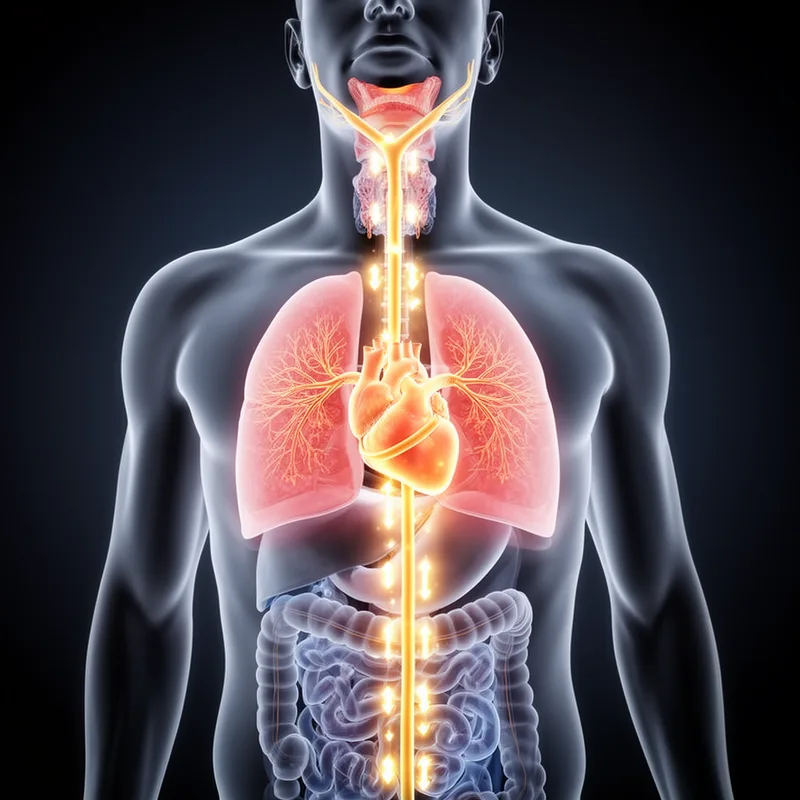
wandering nerve
- noun
- /ˈwɑndərɪŋ nɜrv/
- Specialized
- The surgeon carefully avoided the wandering nerve during the operation to prevent complications.
Examples
-
Damage to the wandering nerve can affect swallowing, speech, and breathing functions.
-
In anatomy class, we learned that the wandering nerve plays a crucial role in controlling the heart rate.
-
The wandering nerve plays a crucial role in heart rate regulation.
-
Many doctors study the wandering nerve to understand its functions.
-
Damage to the wandering nerve can affect swallowing, speech, and breathing functions.
-
In anatomy class, we learned that the wandering nerve plays a crucial role in controlling the heart rate.
-
The surgeon carefully avoided the wandering nerve during the operation to prevent complications.
Synonyms

 3
8.9
3
8.9

A nerve in the chest and belly that helps control the heart, lungs, and digestion
 2
5.5
2
5.5
A long thin part of the body that sends signals from the brain to the heart, lungs, stomach, and intestines
A nerve that helps control heart, breathing, voice, and how the body breaks down food

A nerve that connects the brain to the voice box, heart, and stomach

A main nerve that connects the brain to the heart, lungs, and stomach

A nerve that helps control the throat, heart, lungs, and stomach
Surface Forms
Morphology
A B1 learner who knows 'wandering' (moving about) and 'nerve' (bundle of nerve fibers) can plausibly infer a general sense of 'a nerve that wanders or travels widely through the body,' so the constituents provide helpful cues. However, the precise identification as the anatomical vagus nerve and its specific functions/organ contacts are technical and not fully predictable from the words alone, so the relation is only partially transparent.
Etymology
The noun wandering nerve comes from the idea of a nerve that wanders through the body, going from the head into the chest and belly. That's why doctors also call it the 'vagus nerve' and why the name means a nerve that connects many organs.