
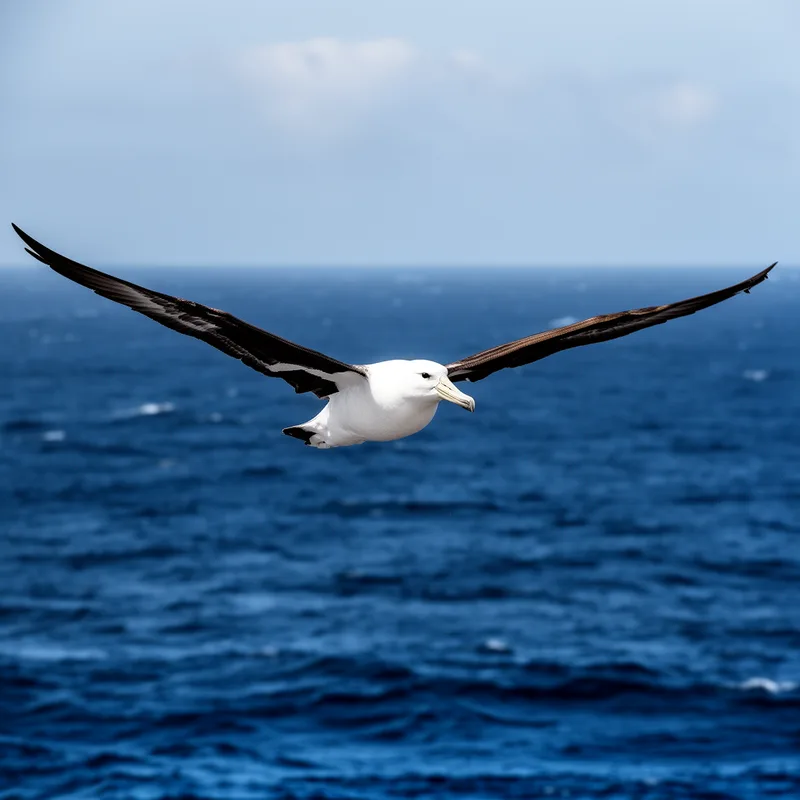
wandering albatross


 1
7.5
1
7.5
- noun
- /ˈwɑndərɪŋ ˈælbətrɔs/
- Australian
- The sight of wandering albatross chicks dotted over the North Plains made it difficult for me to imagine how they could survive anywhere else.
- wandering albatross chick
Examples
-
And slowly and gradually, the sponged clouds came clear on the high-domed ceiling, and once more she was in the company of the gulls and kestrels suspended and the wandering albatross hanging there on wires above her.
Fiction book (1998) -
Now it's not just that, but if we look at the destination area, so the young wandering albatrosses, we find differences between the sexes.
-
And some French biologists put a radio collar on one of these wandering albatrosses and track the mother as she took off to go get lunch for baby.
-
The wandering albatross can soar for hours without flapping its wings.
-
Many scientists study the migration patterns of the wandering albatross.
-
The wandering albatross is known for its impressive wingspan, which can reach up to 12 feet.
Synonyms
 10
1.9
10
1.9
A bird that lives near the sea and often flies over water, like gulls or albatrosses
 9
6.9
9
6.9
A very large sea bird with long narrow wings that glides over the ocean
 1
2.0
1
2.0
A bird that lives near the sea, like a gull
A very large seabird with a white body and broad black wings that flies very far

A bird that lives and travels far out at sea

A bird that lives near the sea, like gulls or pelicans
How Big

Surface Forms
Morphology
The meaning is directly compositional: 'wandering' (moving between places or ranging widely) modifies 'albatross' (a large seabird), so a learner can infer it denotes an albatross that ranges or wanders over wide areas. This adjective+noun pattern is a transparent, cross-linguistically common construction, so a B1 learner who knows both constituents should understand the phrase.
Etymology
Wandering albatross gets its name from a simple picture: wandering shows it travels far over the sea, and albatross is a big sea bird with very long wings. So the name means 'a very large seabird that flies long distances'.