

wagon
 88
1.0
88
1.0

- noun
- /ˈwæɡən/
- On the street, a mule-drawn wagon trundled past, driven by a black man.
- horse-drawn wagon
- wagon train
- covered wagon
Loading YouTube…
Watch on YouTubeWho who created the wagon, who rode in a wagon.
- Who who created the wagon, who rode in a wagon.
- It's a heavy duty hose reel wagon with four wheels.
Examples
-
The trader lifted them into the wagon and covered them with a heavy tarp.
Fiction book (1990) -
We arrived after dusk, and Myrddin left us in the wagon at Tintagel Castle's postern gate.
Fiction book (1991) -
Wait for the wagon and we'll all take a ride
-
What time's that supply wagon outta here, Roman?
-
Ask him to stop the wagon.
-
Let's get the water and provisions into the wagon.
-
Give me those men, Colonel, and some wagons.
-
Everybody had horses and wagons.
-
Silas lifted her easily onto the wagon seat and handed her the reins.
Fiction book (1991) -
The farmer loaded the harvested crops onto the wagon before taking them to the market.
Synonyms
 ∞
1.6
∞
1.6
A machine like a car or bus that carries people and goods
 297
1.0
297
1.0
A small vehicle with wheels that you push or pull to carry things
 11
3.5
11
3.5
A large vehicle like a truck that carries heavy loads
 5
5.6
5
5.6
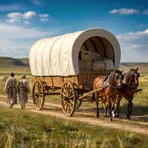
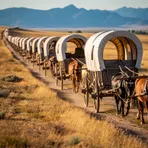
A large wooden wagon with a curved cloth cover used by people to travel across open land
 4
5.1
4
5.1
A vehicle with four wheels like a carriage or taxi that people pay to use
 2
2.6
2
2.6
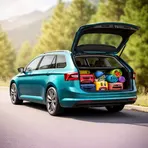
A machine with wheels that carries people or goods
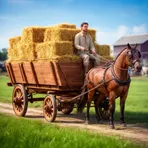
A heavy four-wheeled vehicle pulled by animals or a tractor to carry things

A large covered wagon with wide wheels used by settlers to travel across the plains

A large cart pulled by a horse that carries goods or people
Idioms




Compounds
 5
5.6
5
5.6
A large wooden wagon with a curved cloth cover used by people to travel across open land

 4
5.2
4
5.2
A group or service that brings gifts and information to people who just moved into a neighborhood



- Archaic

 1
9.9
1
9.9
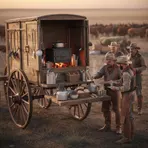
A large covered wagon with broad wheels used by 1800s American pioneers to carry goods



A large covered wagon with wide wheels used by settlers to travel across the plains


How Big

Surface Forms
Etymology
The word wagon comes from old English wægn and old German wagen, both meaning 'vehicle' or 'that which moves'. That early idea of a four-wheeled carrying vehicle explains why a farm cart pulled by animals is called a wagon.