
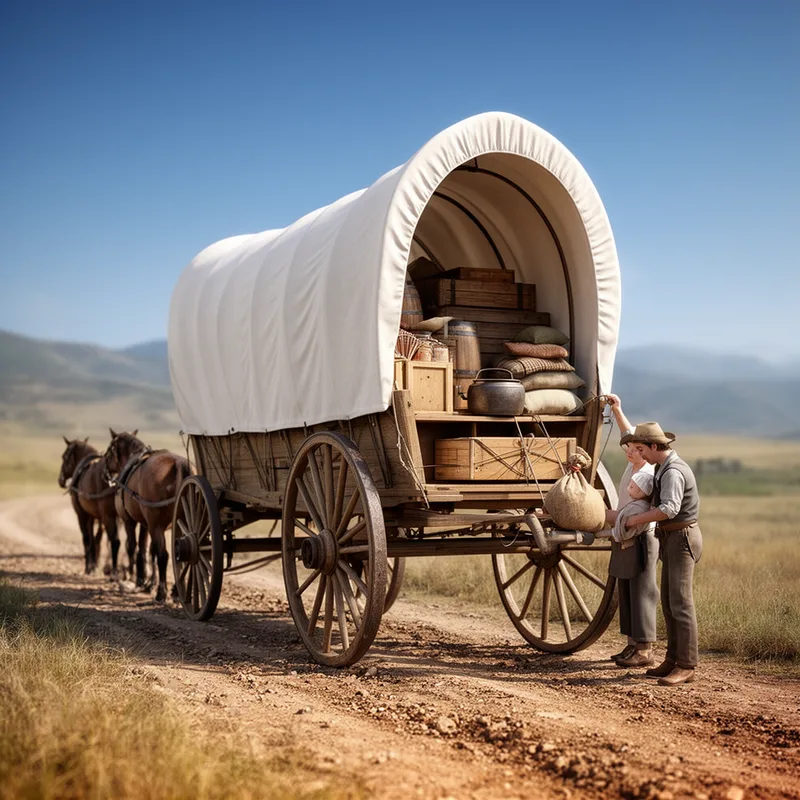
Conestoga wagon


 1
9.9
1
9.9
- noun
- /ˌkɒnəˈstoʊɡə ˈwæɡən/
- Archaic
- During the 19th century, a typical Conestoga wagon featured a large, arched canvas top to protect its cargo from the elements.
Examples
-
A solar-powered car and a Saint Bernard-drawn Conestoga wagon on display reminded residents that gas-guzzling, polluting cars are not the only way to travel.
Academic text (1990) -
How your family brought you west, hidden in the hollow floorboards of a Conestoga wagon.
Fiction book (1994) -
In the pioneer life unit, children studied a fictitious pioneer family who set off in a Conestoga wagon to go west.
Academic text (1992) -
"On this site in April of 1876, a train of 82 Conestoga wagons from Harrisburg, Pennsylvania, was attacked by a Sioux war party," Forrest read out to us.
Fiction book (1992) -
The pioneers traveled for weeks in their Conestoga wagon, crossing vast plains in search of new land.
-
To move their supplies, the settlers used a Conestoga wagon which could carry heavy loads across rugged terrain.
Synonyms
 88
1.0
88
1.0
A four-wheeled vehicle pulled by animals or a tractor to carry goods
 5
5.6
5
5.6
A large wooden wagon with a curved cloth cover used by people to travel across open land

A large covered wagon with wide wheels used by settlers to travel across the plains

A large covered wagon used by early settlers to travel across the prairies

A large covered wagon with wide wheels that early American pioneers used to cross the plains
Surface Forms
Morphology
Conestoga + waggon
The phrase is compositional in that it names a kind of 'wagon' modified by the proper noun 'Conestoga', so a learner who knows both words would infer it refers to a type of wagon. However, the specific historical and structural properties (covered canvas top, broad wheels, use by 19th-century pioneers) are culturally and historically specific and cannot be derived from the constituents alone, requiring prior knowledge.
Etymology
Conestoga wagon comes from the Conestoga region in Pennsylvania, where people first made large, strong wagons with a curved canvas top to carry heavy loads. Because these big vehicles were used by 'pioneers' moving west, the name now means the large covered 'wagon' used on 19th-century journeys.