

uplift
 2
7.0
2
7.0

- noun
- /ˈʌpˌlɪft/
- Specialized
- Subsequent uplift and faulting sliced that variable rock into tightly packed columns.
Examples
-
Large faults crisscross the uplift where sections of the crust have dropped, creating cliffs and intersecting valleys a few miles wide.
Academic text (1993) -
The wrinkles surrounding the uplift were caused by compression of the crust.
Academic text (1993) -
And then in the center there will be a central uplift that usually forms a peak, right?
-
Here, local uplift of the land may have increased erosion and propelled great amounts of sediment into the sea.
Academic text (1992) -
In Neolithic times, the rate of uplift was tremendous—about six inches per year.
Academic text (2010) -
Exploring inland, Darwin and Captain Robert FitzRoy found mussel beds rotting ten feet above the waterline, indicating recent uplift.
Academic text (2009) -
The rapid uplift of the land created dramatic mountain ranges that tower over the valleys.
-
Geologists studied the process of uplift to understand how the Earth's surface changes over time.
-
The uplift in the region resulted from tectonic forces pushing the land upwards.
Synonyms
 125
2.4
125
2.4
A small upward slope in land or a surface
 41
3.4
41
3.4
An upward movement to a higher position
 32
2.3
32
2.3
The action of moving something to a higher place or level
 12
4.1
12
4.1
Raising someone to a higher job or rank
 2
7.3
2
7.3
A movement that raises part of the ground to form mountains
 1
4.1
1
4.1
A rise of land, water, or air to a higher level

A rise in the land when rock below pushes it up
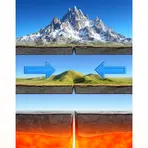
The Earth's movement slowly pushes land higher to form mountains

A rise of land to a higher level when the Earth's crust moves
Antonyms

How High

Surface Forms
Morphology
Etymology
Uplift comes from the simple parts up and lift, so imagine land being 'lifted up' like a heavy block. In geology, uplift means the rise of land to a higher level, as when mountains are made.