
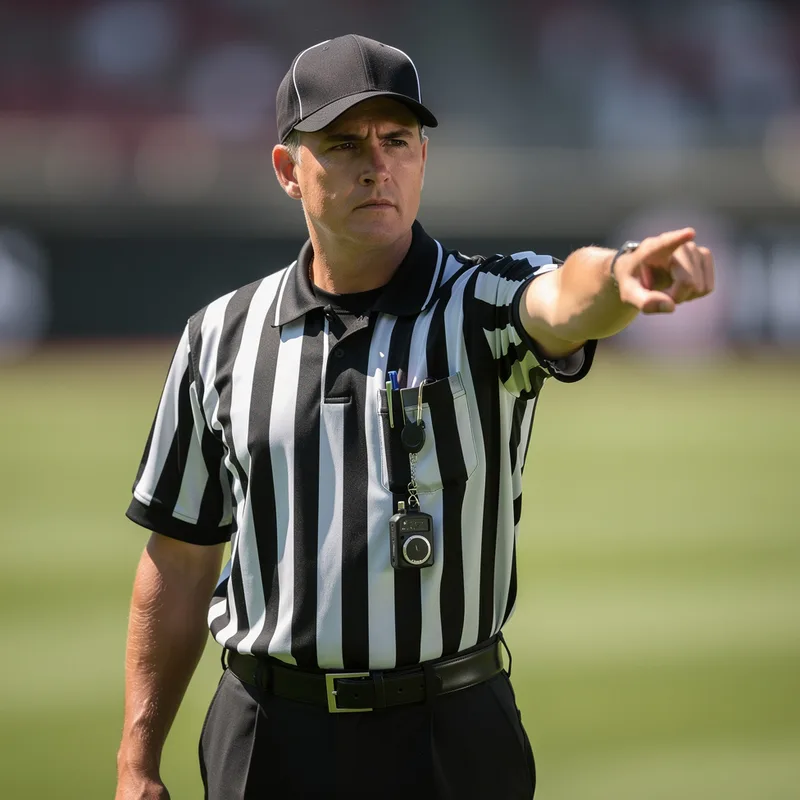
umpire
 54
2.7
54
2.7

- noun
- /ˈʌmˌpaɪər/
- First pitch is a strike; they look back at the umpire with that look.
- the umpire's call
- a baseball umpire
- argue with the umpire
Loading YouTube…
Watch on YouTubeAnd no, there is no umpire calling balls or strikes.
- And no, there is no umpire calling balls or strikes.
- Or for instance, saying I do at your wedding or an umpire saying that's out in tennis.
- And I think the the coaching call from the umpire was probably the wrong call.
- But both umpires and appraisers are humans.
Examples
-
And I think the the coaching call from the umpire was probably the wrong call.
-
Coach Ragemeyer argued interference, but the umpire would hear none of it.
Fiction book (1997) -
So I was playing and and the umpire, well, we actually played together.
-
Maybe, I'll go to umpire school.
-
So you better go tell the umpire there's been a change.
-
What makes baseball interesting is not knowing if the umpire is going to accurately call the ball or the strike on the edges of the strike zone.
-
The purpose of this study was to examine conflict between umpires and players/coaches in amateur baseball.
Academic text (1993) -
" Safe! " roared the umpire as Darren slid across the plate.
Fiction book (2001) -
As the Dodger pitcher argues with the umpire, the Oriole player on third base darts toward home.
Fiction book (2002) -
The umpire made an important call that changed the outcome of the game.
Synonyms
 ∞
3.7
∞
3.7
A person who works for a government or organization and has power to make and enforce rules
 96
2.7
96
2.7
A person who watches a game to make sure players follow the rules
 28
6.7
28
6.7
A person who settles a disagreement and makes a final decision
 19
6.7
19
6.7
A person who hears a dispute outside court and makes a decision both sides must accept
 9
7.0
9
7.0
A person who watches a baseball game and decides if a play follows the rules
 3
7.7
3
7.7
A person who decides a disagreement between people or groups

A person who listens and decides who is right in a dispute or competition

A person who makes an official decision in a court or hearing
Compounds
Surface Forms
Etymology
The word umpire comes from old French parts non- and par, which mean 'not' and 'equal'. It first meant an outside judge who was 'not equal' to either side, and after people said 'a noumpere' the first 'n' dropped, so today an umpire is a neutral person who makes decisions.