
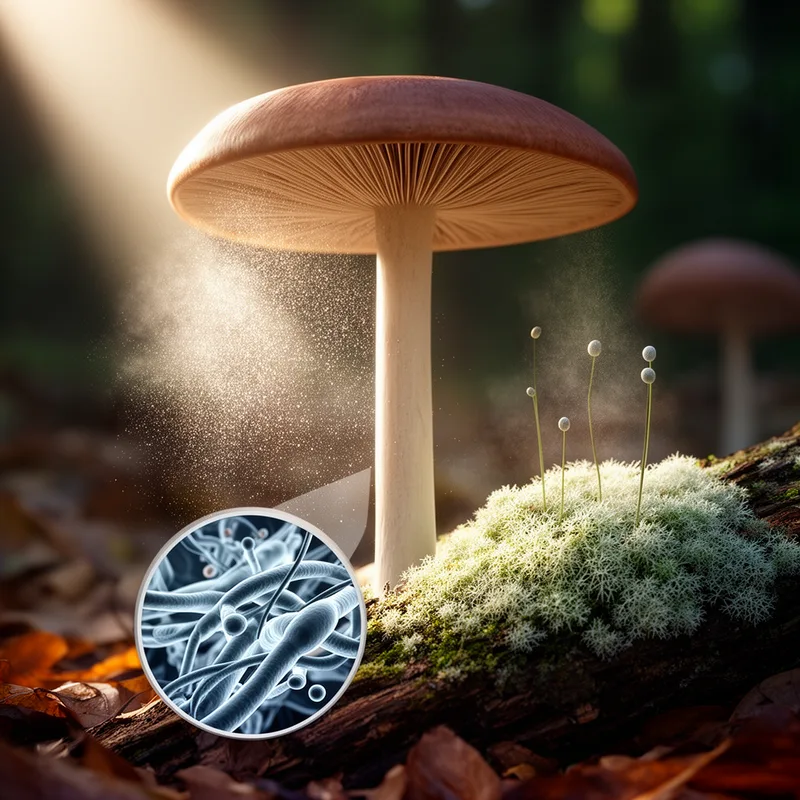
true fungus
- noun
- /tru ˈfʌŋɡəs/
- Specialized
- It characterizes most of the saprotrophic, parasitic, and mycorrhizal Eumycota (true fungi).
Examples
-
Some true fungi play important roles in decomposing organic matter.
-
The region is home to various true fungi that contribute to soil health.
-
One type of mycetoma is caused by actinomycetes (actinomycetomas), and another by true fungi (sinonasal masses).
Academic text (2008) -
Many types of bread are made using yeast, which is a kind of true fungus.
Synonyms

 84
3.1
84
3.1

A living thing like a mushroom or mold that feeds on dead plants and food
 23
4.8
23
4.8
Living things like mushrooms, molds, and yeasts that get food from dead plants or animals

A group of living things like mushrooms and molds that have cell walls and cannot make their own food

A main group of fungi like mushrooms and molds that have cells with walls made of chitin

A group of fungi that have cell walls containing chitin
Surface Forms
Morphology
The adjective 'true' meaning 'genuine' combined with 'fungus' yields a predictable meaning: a genuine/real fungus as opposed to fungus-like organisms. Although used in scientific classification, the relation is fully compositional and a B1 learner who knows both words can infer this distinction.
Etymology
True fungus began as a simple scientific label. Scientists used true to point to the real kind of fungus — not 'fungus-like' living things like slime molds — so today it means fungi that belong to the real fungal group.