
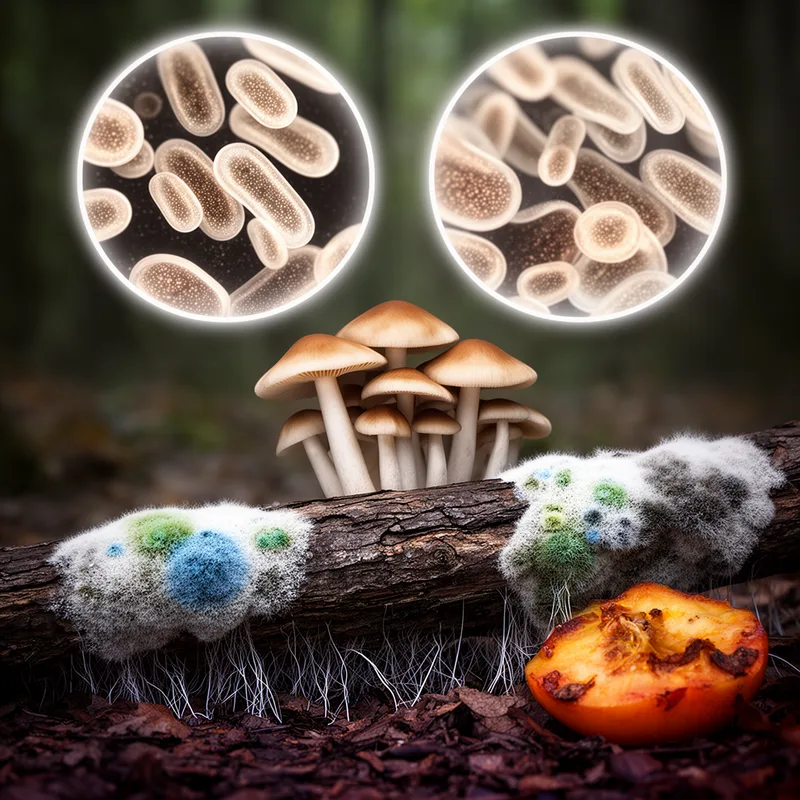
Eumycota
- noun
- /juːˈmaɪkəʊtə/
- Specialized
- The classification of Eumycota helps differentiate true fungi from other fungi-like organisms.
Examples
-
In her research, she found that Eumycota play a crucial part in nutrient cycling in ecosystems.
-
The scientist studied various species of Eumycota to understand their ecological roles.
-
It characterizes most of the saprotrophic, parasitic, and mycorrhizal Eumycota (true fungi).
Academic text (2001)
Synonyms

A main group of fungi like mushrooms and molds that have cells with walls made of chitin

A group of fungi that have cell walls containing chitin
A group of fungi that make zygospores when they reproduce sexually

A former group of fungi that make thick sexual spores
A group of fungi whose spores and reproductive cells can move
Fungi that make swimming spores and are now usually placed in other groups
Compounds
- Specialized
A main group of fungi like mushrooms and molds that have cells with walls made of chitin
Surface Forms
Morphology
Eumycota = Mycota (opaque) = eu + mycota
Although formed by the scientific prefix 'eu-' (true) + 'mycota' (fungi), the term is a specialized taxonomic coinage unlikely to be transparent to an average B1 learner.
Etymology
Eumycota comes from the Greek parts eu- meaning 'true' and myco- meaning 'fungus', the same root you see in mycology, the study of fungi. So Eumycota literally means 'true fungi' and helps you remember it is the group of real fungi like mushrooms, not slime molds.

