

trichloroacetic acid


 1
7.8
- noun
- /ˌtraɪklɔːroʊəˈsiːtɪk ˈæsɪd/
- Specialized
- Trichloroacetic acid can be used to promote healing of persistent tympanic membrane perforations.
Examples
-
During a chemical peel, doctors apply trichloroacetic acid to the face to promote exfoliation and improve skin appearance.
-
I use a microswab dipped in 85% trichloroacetic acid to cauterize the edges of the perforation until the margin of the perforation turns white.
Academic text (2006) -
The authors suggested that 25% trichloroacetic acid might be beneficial in promoting healing; a large randomized clinical trial is needed.
Academic text (2006) -
Clinics often utilize trichloroacetic acid in shallow concentrations for treating specific dermatological conditions.
-
In biochemistry, trichloroacetic acid is used to precipitate proteins from solution during sample preparation.
Synonyms
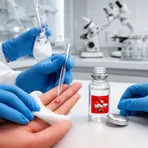
A strong, clear acid doctors and scientists use in labs and medicine
How Acidic
- Specialized
12
4.2

- Specialized
8
4.1
- Specialized
1
7.8
- Specialized
1
4.2
- Specialized
3
3.4
Surface Forms
Morphology
The term is fully compositional: 'trichloroacetic' denotes an acetic derivative with three chlorine atoms (tri- = three, chloro- = chlorine, acetic = from acetic acid) and 'acid' names its chemical class. Given knowledge of both constituents and basic chemical naming, the overall meaning is directly derivable, following regular morphological and nomenclatural patterns common across languages.
Etymology
Trichloroacetic acid comes from a simple description: tri- means 'three', chloro means chlorine, and acetic acid is the mild acid in 'vinegar'. Replacing three hydrogen parts with chlorine makes it much stronger, so it is used in labs to make proteins come out of liquid and in medicine to treat skin. The name helps you remember what it does.