
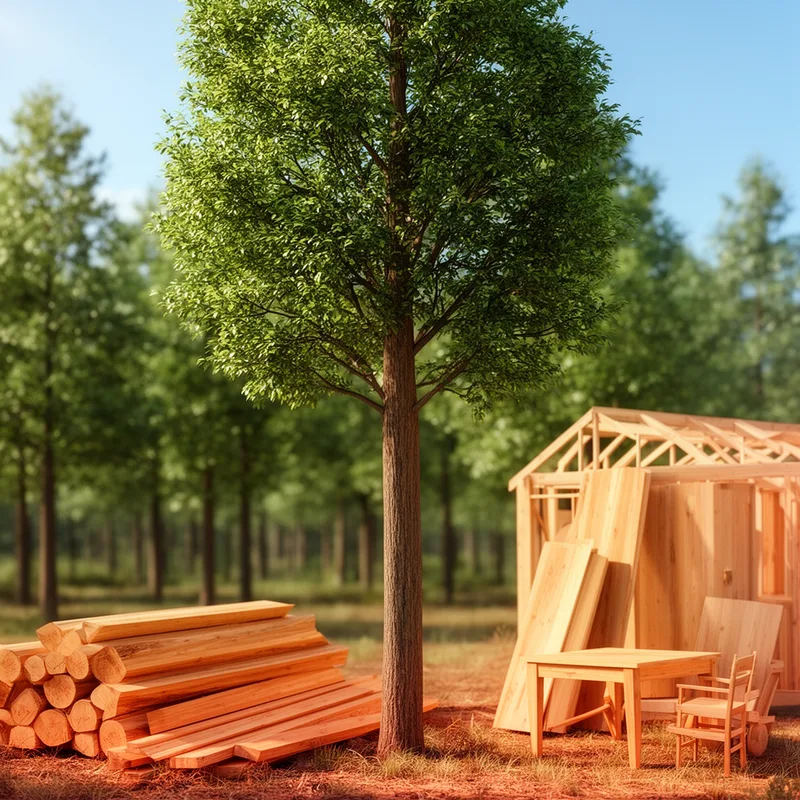
timber tree
- noun
- /ˈtɪmbər tri/
- The forest is home to various species of timber trees that are essential for the local economy.
Examples
-
A large and growing body of research illuminates ever more clearly that industrial logging regimes are several hundred years out of sync with the life cycles of high-value timber trees in the tropics.
Academic text (2012) -
The fund is meant to subsidize planting timber trees on a plantation scale.
Academic text (2000) -
In general, the Akamba women manage fruit trees, while the Akamba men look after timber trees.
Academic text (1994) -
Silvicultural techniques that can enhance the abundance and diameter increment of juvenile timber tree recruits are not yet included in SFM.
Academic text (2012) -
The ironic saga began in 1705, when colonial America's favorite timber tree, the eastern white pine, was first exported to Europe.
Academic text (1998) -
The lumberjack carefully selected the finest timber trees to use for his new cabin.
-
For the construction project, we need to plant more timber trees to provide a sustainable source of wood.
Synonyms
 6
7.2
6
7.2

A North American tree that has edible nuts and hard wood
 3
2.1
3
2.1
A large tree with broad leaves and strong wood often planted in parks and streets for shade
 1
2.8
1
2.8
A large evergreen tree with strong, fragrant wood used for furniture
 1
6.6
1
6.6
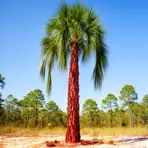
A tall pine tree from the southeastern United States with very long needles and rough red-brown bark
 1
4.0
1
4.0
A tall evergreen tree from western North America with short needles and strong wood

 1
4.4
1
4.4
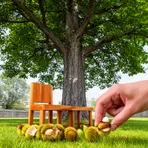
An American tree with strong wood used for furniture that produces edible nuts
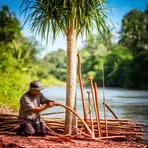
A tropical tree with very strong, flexible wood used for tools and walking sticks

A tropical American tree with hard and long lasting wood used for furniture

A large hardwood tree that makes very dark wood used for furniture and musical instruments

A tree that makes colored, strong wood used for furniture and crafts

A small tree with white flowers and hard wood used for yellow dye, named in the Bible

A tall evergreen tree with two needles per group and light soft wood used for pulp
How Valuable

Surface Forms
Morphology
The phrase is compositionally transparent: the noun 'timber' (wood) modifies 'tree', so the meaning 'a tree valued for its wood' is directly inferable from its parts. This attributive noun + noun pattern is common in English and cross-linguistically, so a B1 learner who knows both words will likely understand the MWE.
Etymology
The phrase timber tree comes from the simple idea of a tree grown to make wood. People would mark a tree as good for timber and later cut it into boards, so the phrase means 'a tree that is a source of lumber'.