
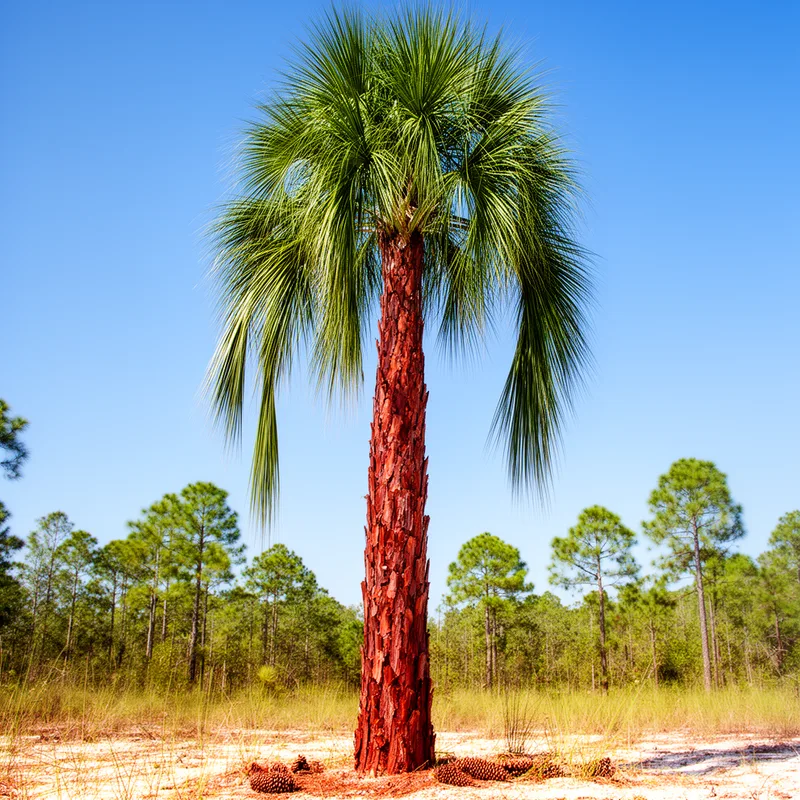
longleaf pine
 1
6.6
1
6.6

- noun
- /ˈlɔŋˌlif paɪn/
- US
- The longleaf pine tree is admired for its tall stature and long, slender needles.
- longleaf pine forest
- longleaf pine ecosystems
- longleaf pines dominate
Examples
-
Habitats in that region include sandy beaches along both the Atlantic Ocean and the Gulf of Mexico and, farther inland, forests of longleaf pine and boggy tracts rich in carnivorous plants.
Academic text (2010) -
The pine community is adapted to periodic fires, which clear out brush and help open up longleaf pine cones, releasing the seeds.
Academic text (2010) -
The area of hardwood forests before European contact was greater than that covered by longleaf pine forest.
Academic text (1994) -
In the same studies, fifteen longleaf pine-dominated and numerous wetland areas were identified.
Academic text (1994) -
In the longleaf pine forests, fire knocks back the dense growth of saw palmettos.
Academic text (1991) -
Ground fires resulting from lightning strikes have been a constant feature of the region's longleaf pine forests through the millennia.
Academic text (1990) -
The region is primarily flat, with stretches of longleaf pine growing in dry sand above an understory of saw palmetto.
Academic text (1993) -
This nutrient-poor soil supports longleaf pine, turkey oak, saw palmetto, bracken fern, and little else.
Academic text (1993) -
At the higher and drier end of the spectrum is a forest dominated by longleaf pines, with a dense, often impenetrable undergrowth of saw palmettos.
Academic text (1991) -
Considerable evidence validates that the longleaf pine was found primarily on the sandiest, droughtiest, most excessively drained land or on wet, sandy, relatively sterile soils.
Academic text (1994)
Synonyms

A tall pine tree of the southeastern United States with long needles and strong wood
How Needle-Long
- US
1
6.6

- Specialized
Surface Forms
Morphology
longleaf + pine
The meaning—a type of pine tree characterized by very long leaves/needles—is directly derivable from its parts: essentially 'long' + 'leaf' modifying 'pine'. This descriptive compounding follows common English naming patterns for plants and is cross-linguistically transparent, so a B1 learner who knows the constituent words would readily infer the meaning.
Etymology
Longleaf pine gets its name from the tree's very long 'needles', literally long + leaf + pine. So, the name means a tall pine tree with very long needles and strong wood.