
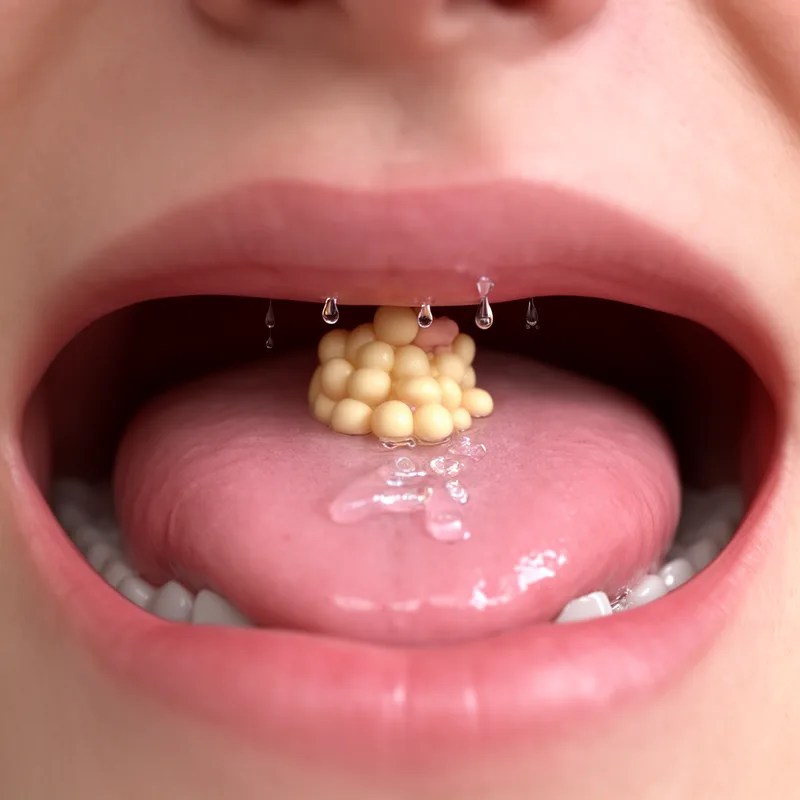
sublingual salivary gland
- noun
- /ˌsʌblɪŋˈɡwɑːl səˈlaɪvəri ɡlænd/
- Specialized
- The doctor explained how the sublingual salivary gland produces mucin to help with digestion.
Examples
-
Inflammation of the sublingual salivary gland can cause pain and swelling under the tongue.
-
During the surgery, they carefully examined the sublingual salivary gland for any abnormalities.
-
At this point, the sublingual salivary gland was recognized and appeared normal.
Academic text (2008) -
However, it was attached to the sublingual salivary gland.
Academic text (2008) -
The normal-appearing sublingual salivary gland was also identified and confirmed as functionally unattached to the mass.
Academic text (2008) -
Histologic examination (Figure 3) confirmed that the mass was a hemangioma and that the sublingual salivary gland was normal.
Academic text (2008) -
The mass, the stem along with the feeding vessels in the region of the hyoid bone, the sublingual salivary gland, and a section of the mucosa of the floor of the mouth were removed.
Academic text (2008)
Synonyms

 3
4.0
3
4.0

A small organ in the mouth that makes saliva to help break down food

A small part under the tongue that makes saliva to keep the mouth moist
Surface Forms
Morphology
sublingual + salivary + gland
The noun phrase is fully compositional: 'sublingual' = under the tongue, 'salivary' = relating to saliva, and 'gland' = an organ that secretes fluids, so the combined meaning ('a gland under the tongue that produces saliva/mucin') is directly derivable. This follows standard anatomical naming patterns found across languages, so a B1 learner who knows the constituent words would understand it.
Etymology
Sublingual salivary gland is named like a simple picture: sublingual means 'under the tongue' and salivary gland is a small gland that makes 'saliva'. So the name points to the small gland under the tongue that makes saliva and helps keep the mouth moist.